Showing posts with label anti-nuclear politics. Show all posts

Thursday, February 28, 2013

The inherent shallowness of "market-based" arguments against nuclear

In the middle of a lengthy takedown of Taxpayers for Common Sense's recent publicity stunt press release proclaiming their "Golden Fleece" award over the DOE's recent award of $452 million for NRC licensing assistance to B&W to construct a first-of-a-kind SMR at the Clinch River site, +Rod Adams brings up an extremely insightful point almost universally neglected in "market-based" critiques of described subsidies for nuclear energy. Specifically, Rod points out a perverse, unintended regulatory consequence brought on by anti-trust laws addressed by the Price-Anderson Act, which governs financial liability in the event of a nuclear accident. (The whole thing is of course well-worth reading.)

Rod points out:
The shared liability approach [inherent to Price-Anderson], if taken without permission, would violate the anti-trust laws that prevent competitors from cooperating. Price-Anderson’s system rewards the industry for sharing detailed technical information that would normally be carefully protected trade secrets. The nuclear industry’s habit of widely sharing important information and lessons learned from experience is one of the foundations on which its excellent safety record is built.
Price-Anderson liability structure
Image: NRC 
To those unfamiliar with how the Price-Anderson liability law works, the NRC has a helpful fact sheet which explains the basics. Contrary to common portrayal, Price-Anderson does not simply act as an "escape hatch" for financial liability for nuclear reactor operators. Each reactor operator is required to hold private insurance for $375 million per individual unit; after this limit is exceeded, a second tier of insurance from cross-pooling across each operating reactor kicks in - up to $11.6 billion. In other words, the liability structure of Price-Anderson explicitly makes it such that "an accident anywhere is an accident everywhere" - there is a shared financial liability across every operator.

The dispute arises of course as to what happens above the $11.975 billion liability threshold - yet this has never actually been tested. (In fact, after Three Mile Island, the worst nuclear accident in U.S. history, $175 million in funds came solely from the "first tier" - i.e., private insurance). Critics are of course free to make their case that the cap is too low - but it first involves an honest reckoning of what the actual liability structure actually is.

More important however, arguments like this tend to underscore a common problem with many of some of these so-called "market" critiques of nuclear energy - even cursory inspection tends to reveal how thin a paint job has been applied to what is primarily a vehicle for advancing a dogmatic anti-nuclear agenda. (I say this too as someone who is almost always first disposed toward market-based solutions.)

Such a harsh critique comes primarily from the shallowness of the arguments presented - which, like TCS's "Golden Fleece," focus primarily on the seen (i.e., the DOE's licensing assistance) and less so on the unseen (i.e., the flawed NRC licensing process which makes it incredibly difficult for new market entrants to feasibly seek design certification). In other words, the "market-based" aspect is simply invoked as a shallow pretext for one-sided arguments applied solely to nuclear energy, rather than across the entirety of the energy sector.

Thus why I highlight Rod's point: A fair free-market critique of the energy industry - nuclear included - would also look at the barriers erected by government regulation (which in turn are what spur the calls for so-called "subsidies" which free-market groups generally oppose). The perverse consequences of anti-trust regulation from information-sharing are an insightful example of this; likewise there is the issue of the regulatory standard for long-term disposal of nuclear waste. For example, a geologic repository for permanent disposal of nuclear waste is required to meet a standard of no more than 10 mrem/year exposure to the public over 10,000 years, followed by 100 mrem/year up to 1 million years. (How one evaluates these begins to leave the realm of engineering and move more into the realm of divination...) To give some perspective - this involves a protection standard equivalent to less than 5% of the average background dose one receives from natural sources over the initial post-closure period, and less than 30% in the million-year period. To put it in more familiar terms, this corresponds maximum exposure equivalent to 1 chest x-ray per year in the first 10,000 years, followed by half the dose from a head CT scan (and 1/10th the dose of a whole-body CT scan) over the next 990,000 years. (Discharges from nuclear plants are regulated still more strictly, at 0.3 mrem per year maximum - less than a standard dental x-ray.)

Ask yourself this - when is the last time you've heard of a coal or natural gas facility being required to sequester their toxic wastes from the public in near-perpetuity? (Likewise even with toxic heavy metal wastes incident to the production of solar panels). How many other facilities are required to pay hourly costs for regulators evaluating license applications (much less put in the encyclopedic licensing applications to begin with)?

The point here is not simply to complain or to justify any special treatment on the part of the nuclear industry - but it does provoke a question of why more so-called "market advocates" in energy only look at one side of the coin. A deeper (and more insightful) analysis would consider the inherent barriers erected as well - including the perverse consequences of features like anti-trust regulations and unequal applications of standards for risk exposure across different energy-producing industries - rather than  cherry-picking analysis we're typically treated to presently - thin gruel, indeed.

Friday, September 14, 2012

Mixing it up over MOX - a wrapup from Chattanooga

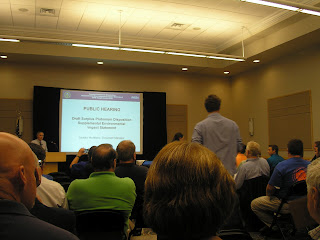
Crowd at the MOX hearingTuesday's meeting in Chattanooga over the draft Supplemental Environmental Impact Statement (SEIS)  over potential plans by TVA to use MOX fuel fabricated from surplus weapons plutonium had no shortage of passion. The meeting drew a packed house of MOX supporters and professional anti-nuclear activists ("professional" in the sense that these individuals clearly make a career out of attending such hearings).

Surprisingly absent however was any evidence of nuclear zombies; while the opponents employed some degree of necromancy in their arguments, no "nuclear zombies" were spotted at the meeting. (To which I wryly observed during the meeting, "All that zombie defense training for nothing...")

For those who missed it, I did a bit of live-blogging at the ANS Nuclear Cafe as well as live-tweeting the meeting (as @sskutnik, under the tag #MOXchat - and #MOXsnark as my snarkiness level progressively increased throughout the meeting...) Meredith Angwin of Yes Vermont Yankee was following the meeting via Twitter and has already posted her thoughts; I've been a bit delayed up until now (such is the life of a professor...), but I wanted to get in my impressions from the meeting.
UTK ANS students

Strong turnout

We had an extremely healthy contingent of students in attending, both from the University of Tennessee (where we had a little over 20 overall) as well as Chattanooga State's local ANS section (as seen in the bright blue and orange shirts in many pictures). A great deal of credit for this goes to Laura Scheele, the Outreach and Public Relations director for ANS national, who coordinated with both the UTK and Chattanooga State sections as well as organizing a welcome hospitality room (always popular with students!)

Also in attendance was Suzy Hobbs-Baker of PopAtomic Studios, who put together some very cool pro-nuclear signs. (One anti-nuclear activist who wandered into the hospitality room as Suzy was putting together some of her signs before the meeting rolled her eyes and said, "You have got to be kidding." Whimsy, it would appear, is lost upon the opposition. Such a lack of whimsy of course did not stop her from helping herself to some cookies courtesy of ANS.)


No zombies, but zombie arguments

As I noted above, there was a surprising absence of zombies at the Chattanooga hearing; we speculated as to whether the budding thespians had caught wind of our plans to organize on the hearing and decided to head off to greener pastures (or at the very least, softer targets).

In a rare, refreshing display of honesty, one housewife-cum-activist (this being pretty much her own self-description: "My husband pays the bills, which allows me to do this full-time"), while reading off of a notecard of pre-prepared talking points, admitted, "I don't really understand this, but I'm going to read it anyway..." There were numerous "technical" (speaking very generously) arguments of dubious merit pertaining to MOX fuel - they could be summarized essentially as follows:

  • MOX fuel burns (thermally) hotter, so it's more dangerous
  • These reactors "weren't designed" for MOX fuel
  • MOX fuel is ill-understood and experimental
  • MOX fuel with weapons-grade plutonium behaves differently than reactor-grade plutonium
  • MOX fuel leads to much more rapid neutron embrittlement of reactor pressure vessels
Some of these arguments I've handled before, but let's go through them again. 

Thermal output


As to the thermal output - indeed plutonium does release somewhat more energy than uranium upon fission. However, the reactors are being run at the same thermal output - which is controlled the same way we control uranium-only cores: with chemical shims (like soluble boron), burnable poison rods, and control rods - all of which keep the total temperature of the reactor the same as before by controlling the rate of fission.

Reactor physics of MOX fuel


The next three arguments essential come under the same umbrella - the myth that MOX fuel is somehow new and ill-understood. MOX fuel itself has been used for decades around the world in countries that reprocess used nuclear fuel, so the idea that it's somehow ill-understood is clearly false on face. 

Beyond this, many of the opponents arguments came from half-complete understandings of how reactors work; it was particularly apparent that they were being fed cherry-picked half-truths to convey a sense of technical credibility to their arguments. For example, opponents argued that MOX fuel makes the reactor more difficult to control. In a limited sense, this is true; plutonium has about 1/3 the fraction of delayed neutrons (~0.2%) as U-235 (~0.64%). 

[Aside: In reactor theory, neutrons come in two forms - "delayed neutrons," which come from fission products or decay products (on the order of a few milliseconds to a few minutes after fission), and "prompt neutrons," which are the neutrons released at fission. Reactors are typically run as "delayed critical" - meaning that the delayed neutrons are the component which keeps the chain reaction going; the reactor is in fact subcritical (not self-sustaining) from prompt neutrons alone. The existence of delayed neutrons is what allows for a reactor to be safely controlled, namely by allowing for smooth, easily controlled changes in reactor power.]

Here's the problem with the opponents' argument; nobody is proposing to run a full core solely upon plutonium fuel. Rather, the TVA proposal would, at a maximum be looking at a 40% core of MOX fuel, ramping up from an initial loading of around 4%. Further, there is of course an ongoing trend with nuclear opponents, that somehow there is a completely non-existence of an engineering discipline. A key issue to stress here is that before any fuel assembly is loaded into a reactor, an inordinate amount of engineering work is done to know just how the fuel will behave to ensure it will be done safely. No one is simply doing engineering by the seat of their pants, contrary to the beliefs of some.

Once the argument that MOX fuel is somehow "experimental" is knocked down, opponents quickly come back with a new variant - that somehow plutonium of weapons-grade variety (i.e., with a Pu-239 content over 90%) behaves substantially differently than that of reactor grade origin (where Pu-239 is about 55-70%, with about 20-25% Pu-240).

Pu composition by reactor type

With plutonium, odd-numbered species (Pu-239, Pu-241) are "fissile," meaning they will fission with thermal neutrons (i.e., the kind which exist in a light-water reactor). Even-numbered plutonium species will not; they typically absorb neutrons to become odd-numbered plutonium species (e.g., Pu-240 will become Pu-241), meaning these species have a net negative reactive worth (i.e., they parasitically absorb neutrons).

However, once again - these are things which are well-understood from an engineering perspective; the amount of plutonium in the MOX rod is determined by how much "reactive worth" is necessary. One of the students who spoke (and was later quoted by the Times-Free Press) has actually studied this exact issue (differences between weapons-grade and reactor grade plutonium for reactor fuel) and found minimal differences in reactor behavior. In other words, this is most certainly not some "experimental" fuel never tried before - all of this is well-understood physics.

Everyone's a reactor engineer...


The same goes for whether reactors are "designed" for MOX fuel; reactors are designed to remove efficiently remove heat from fuel rods and contain radioactivity. Reactor cores are designed to distribute fuel assemblies such that the rate of fission (and subsequently reactor power) is as evenly distributed as possible, with minimal peaking. Thus, the argument that somehow reactors are not "designed" for MOX-loaded cores run at the licensed and designed reactor power is utter nonsense, based upon a total misunderstanding of how reactors are designed and operated.

Finally, one of the most bizarre and self-contradictory arguments was the idea that MOX fuel will uniquely lead to accelerated materials issues with reactor pressure vessels - i.e., neutron embrittlement. Again, an argument based upon a half-truth. The average number of neutrons released in fission by plutonium is again higher than uranium (a quantity known as "nu-bar"; nu-bar for Pu-239 is about 2.98, compared to 2.6 for U-235, about a 15% difference). However, the actual quantity of interest - the neutron flux (i.e., the number of neutrons actually flying around in the reactor) is directly proportional to the rate of fission - itself proportional to the reactor power. In other words, if the reactor power is held constant, all other things being equal the neutron flux will also be about the same. (There are some minor differences here, getting deeper into the technical details, but the end result is that the net difference in neutron flux basically ends up being a wash.) In other words, the argument that somehow plutonium-based fuels will somehow uniquely lead to accelerated neutron embrittlement is utterly bogus - completely notwithstanding the fact that NRC regulations require regular sampling of reactor pressure vessel materials (a "coupon" is taken from the vessel itself and tested for properties of embrittlement).

...or an economist


Not surprisingly, many armchair economists were also present among the opponents, with several pointing out the fact that the disposal of surplus plutonium in MOX fuel costs more than vitrification and disposal in a geologic repository (in this case, likely WIPP in New Mexico) in glass logs. A response to this - repeatedly brought up by myself and others present is that fissioning the plutonium is the only way it can ultimately be permanently destroyed. (This perhaps most brilliantly summarized by Dr. Howard Hall, who noted that "as a chemist, the most difficult thing for me to do is to put an atom back together after it's been fissioned.") Opponents also neglect a few key issues as well - the first and most important of which is that we have a standing agreement with Russia to destroy this plutonium in MOX fuel, namely because of Russian concerns about future retrievability in glass log form. (While the plutonium is rendered far more inaccessible in glass log form compared to its original metal pit form, it is clearly not impossible even with present technology to recover; by contrast, plutonium fissioned in MOX fuel is both destroyed, with the remaining material both contaminated with "nuisance" species like Pu-240 and Pu-242 as well as being trapped in a form which would need to be processed, while being protected by a lethal radiation field.)

Additionally neglected is the fact that the DOE has already made the decision to go the MOX route and has already invested considerable resources in making this happen, meaning any savings argument is moot; the meeting at this point involves TVA's decision to accept the MOX fuel for reactors. (Topical limitations did not stop MOX opponents from airing a laundry list of complaints against nuclear energy writ large, particularly with respect to TVA.) However, even assuming abandoning the MOX program was under consideration (neglecting technical concerns and focusing strictly upon the economic argument being presented), given the funds already committed to the MOX fabrication facility, we are well past the point where vitrification (a technically inferior solution) would even save money on the balance.

Of course, economics was not always the strong suit of opponents; a particularly amusing moment of the evening was when one opponent began his speech indicating how he hadn't paid an electric bill in over two years thanks to his home solar panels, then proceeded to preface an argument against the relative economics of MOX by saying, "As a TVA ratepayer..." It was quite clear that the meaning of "ratepayer" wasn't quite understood.

The importance of being nice

One of the most surprising things to me about the overall tone of the meeting was the general air of civility in the affair. Perhaps my expectations had been set too low on the basis of some of the zombie theatrics of Greenpeace types at prior TVA hearings (not to mention some of the horror stories Meredith Angwin has reported in connection to Vermont Yankee meetings), but overall MOX proponents and opponents alike were polite and respectful of one another. (This did not prevent the odd condescending remark from the protestors - one of the more personally enraging ones went along the lines of, "I'm glad to see all the students here tonight - but we don't need cheerleaders for MOX here, we need solutions." As if the years of hard work students put into their degree programs is irrelevant.)

One thing I stressed to students beforehand was the sage advice I took to heart from Meredith: be nice. (And if you can, bring friends.) More importantly, I tried to stress the importance of being courteous and respectful even in the face of opponents who at times took a hostile, dismissive, or even condescending tone. (At several occasions in the evening Angwin was referred to as our "patron saint" of pro-nuclear activism...) [Edit: Meredith notes that her frequent co-blogger / co-activist Howard Shaffer is even more active; I would happily amend to note the two as "co-patron saints" of nuclear activism...]

A particularly interesting facet of the meeting was in how one could readily identify MOX opponents before they even got to their arguments - solely by their tone of voice. In nearly every case, opponents would grow progressively louder as they spoke, some nearly shouting by the end (despite the presence of a microphone and room small enough that none of this was necessary).

That being said, each side respectfully allowed the other to speak - there were no disruptions or booing; generally speaking, there was even polite applause for each speaker despite whose side they represented. (An interesting finish to the story; when we wrapped up and headed out to dinner afterwards, the opponents ended up at the same restaurant, sitting at a table right next to us. While there was some mildly belligerent exchanges between one opponent and one of our students, generally speaking both sides were again polite and respectful to one another.)

Showing up matters

Lest anyone doubt the impact of knowledgable people simply showing up at meetings like this, I offer the following exercise in compare & contrast: Take a look at the coverage of the MOX hearing in Chattanooga (attended by an overwhelming number of ANS local section members from the University of Tennessee and Chattanooga State) versus the hearing on Thursday in Decatur, Alabama (near the Brown's Ferry reactor, one of the proposed TVA sites for burning MOX fuel). (For further contrast, have a look at the before and after reporting of the Chattanooga meeting as well).

The distinction in coverage when knowledgable nuclear advocates are present could not be more clear; in their absence, a small caravan of nuclear opponents traveling from meeting to meeting are allowed to speak unopposed as the singular voice of "the public." (Take a look at the articles and see if you can't spot some repeated names, for example.) There is little question in the Decatur coverage whether a contingent of the public exists who supports the program (apparently, they don't) - instead, opponents have been allowed to freely carry the day, completely unchecked.

Without trying to belabor the point too much: showing up matters. Reporters have no technical basis to evaluate the questionable claims of nuclear opponents (which really, the MOX opponents unabashedly represented); nor do reporters have any reason to seek out the existence of an opposing view when it is absent from public forums such as these. By contrast, when knowledgable individuals show up to these meetings, particularly in large numbers, their presence simply cannot be ignored - even if their numbers may be underreported. (The Chattanooga Times-Free Press reporter indicated about a dozen students were present; by my count, we had about two dozen from the University of Tennessee alone in two vans, not even counting the over two dozen from Chattanooga State.)

Final thoughts

Something to stress here in all of this - and again, something I made sure to emphasize with the students coming on their own time despite busy class schedules - is that in addition to the simple importance of speaking out at events like this (something I feel is an ethical obligation of nuclear professionals), one of the most important aspects here is to have fun. Outreach events like this can be stressful, especially with opponents ready to label students as simple shills or puppets of the "nuclear corporatocracy" to use one opponent's terms. Some of this came from having some fun with opponents' catchphrases - "Don't fall into the MOX pit!" and "Are you cheerleading or finding solutions here?" were repeated more than once in humorous fashion afterwards.

Events like this fulfill a vital part of the role of organizations like ANS to inform the public such that decisions are made on the basis of facts and not simply demagoguery, but that also doesn't mean that they can't also be a fun way for students and professionals to get together to share their passion for technology they see as vitally important for society's future.

Monday, September 10, 2012

Wading into the "nuclear zombie" horde

Tomorrow evening, the NNSA will be hosting a public meeting concerning its Supplemental Environmental Impact Statement on the disposition of surplus weapons-grade plutonium (WGPu) as mixed-oxide ("MOX") fuel for consumption in power reactors.

This is not a new policy - the decision to dispose of the surplus weapons material was put into place during negotiations with the Russians which took place during the Clinton Administration. The goal was quite simple: with the Cold War at an end, both countries had far greater stocks of weapons material than reasonably necessary for defense, and disposing of this material was determined to be a national security priority. In particular, both the U.S. and the Russians have agreed to dispose of 34 metric tons (about 75,000 pounds) of surplus bomb material.

Such an agreement is similar in form to the "Megatons to Megawatts" program now winding down, in which surplus highly-enriched uranium (HEU) formerly for weapons was down-blended into low-enriched uranium (LEU) for reactor fuel and permanently destroyed.

Scrambled eggs / plutonium
The NNSA proposal works along the same lines - take what is currently a weapons-grade asset and blend it down (in this case, convert the plutonium into an oxide powder and blend it to about a 4% mixture with uranium) and then burn it in reactors. The advantage to this approach is relatively straightforward: by burning the plutonium in reactors, the plutonium isotopic makeup becomes "scrambled" - basically rendering it useless for weapons, even if it were ever recovered from the spent MOX fuel. Further, the irradiated fuel adds a second physical barrier to theft and diversion - namely that now this material is now trapped inside a highly radioactive fuel rod. (The treaty agreement likewise forbids the two countries from reprocessing the spent MOX fuel for several decades.)

So who would object to what sounds like a sensible application of the "swords to plowshares" concept?

Zombies.

Specifically, "nuclear zombies." Greenpeace and other anti-nuclear activists, in continuing their slow decline into generalized misanthropy over any stated concern for the environment, have come out in force against the NNSA proposal, going so far as to set up shop in Chattanooga. Their particular M.O. in this has been a series of "nuclear zombie" theatrics - starting with a TVA hearing on completing the mothballed reactor project at Watts Barr Unit 2. The anti-nuclear critics leaped upon the construction restart as reviving a "zombie" reactor build (once dead, now undead - yes, clever there folks) and have been working with the meme since.

In keeping with the theme, I'll be leading a contingent of trained nuclear engineering students zombie hunters  from the University of Tennessee down to the public meeting tomorrow both as a show of support and more importantly as a resource in trained experts who can sort the facts from the theatrics.

As always though with zombies, it's important to remember the most important rule of dealing with zombies: Always remember the double-tap. As we prepare for the charge into the zombie horde, it's thus useful to put down a few of the "living dead" arguments out there which seemingly seem to lumber on from beyond the grave. As a good companion piece, I also highly recommend Dan Yurman's full frontal assault on the zombie horde.

Zombie argument #1: MOX fuel is unsafe

Several countries, including France and Japan, already use MOX fuel in their reactors. This plutonium comes from recycling the plutonium that is built up in uranium fuel as reactors are operated. (Thus, to emphasize: plutonium in reactors is not a foreign concept - in the course of regular operations, plutonium is built up and burned within the fuel. In fact, near the end of a fuel bundle's lifetime, much of the energy produced from fission comes from the fissioning of plutonium itself, in addition to the depleting fissile uranium in the fuel).

Plutonium fuel does burn a bit "hotter" (fission releases a nominally larger amount of energy for plutonium compared to uranium), but as Yurman points out in the above article, this is relatively similar to how a wood-burning stove works. Certain woods burn hotter (think hardwoods); but control of the reactor power and temperature is governed by many devices beyond the fuel, including burnable poisons and control rods which regulate the reaction rate. The goal of MOX fuel is essentially to use it as a replacement for ordinary uranium fuel - meaning the reactors are to run at the same power level as before. This is a well-understood concept.

Further, the MOX fuel would not compose more than a fraction of the core loading. Yurman points out that TVA's initial plan (if they decide to participate in the MOX fuel program) would likely involve starting out with a loading of about 8 assemblies in the reactor; pressurized water reactors typically will have around 193 assemblies, meaning MOX will start off making up around 4% of the core, with an eventual ramp-up to around 40%.

Zombie argument #2: MOX is an inferior way to dispose of plutonium

Of the more sophisticated "zombie arguments out there, one that seems to arise again and again is the idea that disposing of plutonium in MOX fuel - be it from civilian reprocessing or from disposal of surplus weapons materials - is an inefficient and expensive way to deal with the problem. Instead, they say, we should dispose of the material in glass logs ("vitrification") and then bury the glass logs in a deep geologic repository. Such approach has been vocally promoted by the now-current chairwoman of the NRC, Dr. Allison MacFarlane. (Have the zombies gotten to her too, do you suppose?)

In particular, some critics have pointed out the formerly proposed "two track" approach first sketched out by scientists and engineers with the Department of Energy at Savannah River, where the conversion of weapons material will take place. There are of course two problems with this - the first being that this approach was originally proposed because of identified problems in handling about 9 metric tons of the plutonium, as it was contaminated and deemed potentially unsuitable. (The remaining 25 metric tons were to be converted into MOX). However, as those problems were overcome, the decision was made to proceed exclusively on the MOX track, thus saving money by not creating two separate facilities.


From a strictly technical standpoint, disposal of surplus plutonium in MOX fuel is the preferred pathway of numerous technical and scientific organizations, including the National Academy of Sciences, the American Nuclear Society, as well as numerous academic organizations, including the Harvard Project on Managing the Atom. (It's rare when I agree with the last party, so you know there's something going on when that one happens).


Second, and perhaps more important, is the fact that there is significant diplomatic pressure from the Russians to convert and burn the material as MOX fuel rather than to vitrify it, as they are concerned that the vitrified material encased in glass logs may one day be recoverable. By contrast, once the MOX fuel has been irradiated, not only is the material far more difficult to handle, but the plutonium content itself becomes contaminated with "unfavorable" species of plutonium which render the material unusable for weapons use. Thus, the MOX route represents a more permanent disposal pathway.

Finally, a factor which should not be neglected, is that MOX fuel represents a viable way to extract a useful resource - energy - out of what was formerly simply an implement of mass destruction. One can quibble that the economic costs of the MOX route do not necessarily outweigh the economic value of the electricity produced, but regardless the material would have to be converted into a form suitable for disposal - be it for conversion into glass logs or into reactor fuel. In this regard, it is useful to look at this from a marginal cost perspective - i.e., the benefit of electricity should not be weighed against the full cost of the MOX fabrication facility but against the marginal difference in the cost of the MOX facility versus vitrification. In this regard, MOX begins to look like a much better deal, even if it doesn't break even. (Lacking for immediately accessible numbers, this is difficult to quantify).

Zombie Argument #3: Nobody wants MOX

A relatively specious argument which can be relatively swiftly put down. First, TVA has expressed interest - hence why these hearings are taking place in the first place. In addition to TVA, Duke Energy has also expressed potential interest in purchasing the converted MOX fuel from the Savannah River Site.

Most of the reason U.S. utilities have been reluctant to purchase MOX fuel for reactors up until now comes down to cost - pound for pound, MOX fuel does cost more, and utilities receive no credit back toward fees paid into the nuclear waste fund for any net reduction in waste sent to an (eventual) repository. (The Megatons to Megawatts program, by contrast, produced a fuel which is the same exact form as used in current reactors - hence, it was cheaper and easier).

However, because the NNSA plan is explicitly designed to dispose of surplus weapons material, it is being done with a subsidy to offset this cost. (Again, to emphasize: what is being paid for is to ensure a final disposition of the plutonium.)

Closing thoughts

Like with ordinary zombies, I'm not even really sure we can expect the level of sophisticated arguments that I've deconstructed above so much as a slow grope for brains. (Yes, cheap shot, I know.) I say this only because I remain unconvinced that "nuclear zombie" demonstrations, which Greenpeace and other anti-nuclear organizations have invested considerable resources into, have anything to do with setting the tone for well-reasoned, thoughtful consideration of alternatives.

Ash with his boomstick
If you need to find me at the meeting tomorrow, I'll be the guy with the
boomstick
. (Note: No one's bringing any weapons. Please don't sue.)
Regardless, I will be there tomorrow, braving the zombie horde. If you're anywhere around the Chattanooga area tomorrow, do consider joining us. One of the key points I have continued to emphasize with my students is the need to simply show up - not only such that groups interested more in theatrics than in debate don't simply carry the day by default, but also such that we can be there as a resource - answering questions from the non-zombified public and putting to (final) rest some of the more putrified misinformation.


The hearing will be at the Chattanooga Convention Center (1150 Carter Street
Chattanooga, TN). Open house starts at 5:30, followed by a technical presentation by the NNSA at 6:30 and public comments following up 8:00.

Tuesday, September 4, 2012

A cost-free way to open up nuclear investment

Late last week, the Atomic Safety and Licensing Board (ASLB) rejected a license application for the proposed Calvert Cliffs Unit 3 (an AREVA EPR) build in Southern Maryland. The reason? It was against the law.

Specifically, when the build was originally proposed, it was to be a 50/50 joint ownership stake by Constellation Energy and Electricite de France (EDF, the state-owned French utility giant). However, in November 2010, Constellation sold its 50% stake in the reactor to EDF, making it the sole potential owner of the unit.

According to Federal law (10 CFR 50.38), foreign investors are ineligible to apply for a license to operate a nuclear facility in the U.S. While Unistar was still the nominal applicant, the ASLB determined that the venture was solely owned by EDF and thus EDF was the effective applicant - and thus, ineligible. (The lawsuit, incidentally, was filed by the anti-nuclear activist group NIRS, indicating that anti-nuclear groups will not hesitate use every tool at their disposal to block or shut down any nuclear power facility - and to hell with the cost to the environment as a result.)

If this seems entirely backward in a world of global production and investment, that's because it is. The current regulation is an artifact of the Atomic Energy Act of 1954, which first authorized private ownership of nuclear facilities. (Prior to this - per the Atomic Energy Act of 1946, all nuclear technology was considered a state secret, during the short time in which the U.S. enjoyed a monopoly on the technology.)

Is there any real compelling reason for restrictions on foreign ownership and investment in nuclear facilities to exist at a time when the U.S. holding a monopoly on the technology has long since passed? Issues of safety here of course are irrelevant - the facilities would be licensed and regulated by the NRC, just as any other nuclear facility is now. About the only salient objection is the political one - i.e., the implications of a foreign entity maintaining controlling ownership in key infrastructure. (Although it's hard to see anyone getting particularly upset about the reverse - U.S. entities owning a controlling stake in infrastructure in other nations.)

For those who have a bit of a longer memory, the controversy should ring familiar - i.e., it's the same arguments which were played out during the Dubai Ports World deal, in which DP World, a UAE-based company, would take over management contracts for six U.S. ports already under foreign management.

EDF as Philip J. Fry: Shut up and take my money
Meanwhile, an issue to consider is the fact that bringing together capital to complete a construction bid like Calvert Cliffs 3 is no mean feat (particularly in an economy where investors seem all too skittish about long-term investments in energy infrastructure). Given the difficulty then, it seems positively insane for any political leadership to turn away large investments in long-term energy infrastructure (especially non-emitting baseload like nuclear, which has a long expected operational lifetime).

Setting aside the politics of free trade for a moment, if Republicans have any seriousness behind their twin rhetoric of advocating for expanded use of nuclear energy and in relying on the free market to sort out our energy mix, then this one should be a no-brainer: let companies like EDF put up the investment and apply for a license. The same is true for Democrats as well - if they're serious about both jobs (nuclear construction has them in spades) and especially about creating clean energy sources for the future, investors like EDF should be welcomed with open arms, not turned away at the door.

Again, the best part of this? This costs nothing. Investors like EDF wish to voluntarily invest their money in a vital public good (carbon-free electricity) - all that needs to happen is for leaders to be willing to say, "Oui."

Tuesday, June 26, 2012

Deconstructing anti-nuclear economic myths - a response to Veronique de Rugy

Let me start things off with a disclaimer - I am not an economist. I don't even pretend to be an economist; I'm a nuclear engineer by training (I hold Ph.D. in Nuclear Engineering). That notwithstanding, economics (and specifically, the economics of energy) are a side interest of mine. So it was with mixed interest and trepidation when I read a recent piece by libertarian economist Veronique de Rugy from the upcoming July issue of Reason, entitled "No to Nukes."

Plausibly, de Rugy's animating complaint (given Reason's market-oriented focus) is in the subsidies for new nuclear (specifically, when I followed up with de Rugy on Twitter, she pointed out the issue of loan guarantees, although nowhere does this specifically appear in her piece). The piece itself is nothing new, however - the bulk of it is in fact a retread of a suspiciously-timed nuclear hit piece which appeared literally two weeks after the Fukushima disaster. (One gets the distinct impression that, despite her protestations to the contrary, de Rugy is more than happy to dance on what she perceives to be nuclear's grave, particularly given her timing and choice of targets.) In reality, the piece seems to follow on to a frustrating trend of pro-fossil contrarianism as of late, particularly in libertarian circles (contrarian in the sense of singling out the most economical, carbon-free competitor to fossil fuels for special scorn on economic grounds); although perhaps this contrarian turn owes to the fact that conservative heavyweight think tank Heritage has cornered the market in advocating nuclear energy as a free-market energy source. (Who said hipsterism is limited to fashion and terrible beer?)

de Rugy's piece begins with an overly long introduction detailing to the reader why nuclear power was destined to fail to live up to its promises, including citing public opinion which she describes as having " remained steadfast against the technology ever since [Three Mile Island]" (although someone may want to refer de Rugy to the latest polling data on the subject), along with other issues, such as "[d]isputes over waste disposal [which] have never been resolved" (once again however, these are political rather than technical matters).

Finally we get to the meat of the matter - it would appear that a restart of the nuclear industry is, "[...]not just bad politics. It’s awful economics." Well.


To this end, de Rugy characterizes the recent decision by the NRC to grant Southern Nuclear company a license to build two new AP1000 units at the Vogtle site - the first new units in 30 years, as "[...]an act of desperation by a president who has realized he is running out of other options." Fortunately, contrary to the opinions of a economists with a particular axe to grind, the decision to award Southern Company is not in fact in the hands of the president, nor are operating licenses granted upon individual opinions about economic viability of the project - they are voted on by the commissioners of the NRC on the basis of safety alone. This fundamental misunderstanding of the process is pervasive throughout the rest of the piece.


Levelized cost of electricityMuch of the piece is particularly scarce on actual sources and utterly devoid of hyperlinks (however, given the fact that the piece is a re-tread of her prior post-Fukushima piece, most of her sources appear to be taken from there). de Rugy cites a 2009 MIT study by Ernest J. Moniz and Mujid S. Kazim as evidence of nuclear's uncompetitive costs; one assumes she is referring to MIT's "Future of Nuclear Power" project which includes cost projects of nuclear compared to other conventional fossil sources under a variety of circumstances. In the 2009 update, it reports the following cost comparison: assuming current cost of capital, coal clocks in at 8.4 ¢/kWh, natural gas at 6.5 ¢/kWh, and nuclear at 8.4 $/kWh. The authors specifically note however that this includes a current "risk premium" to capital costs for nuclear - recalculating capital costs at comparative market rates (absent the "risk premium"), they come up with a number far closer to gas and coal: 6.6 ¢/kWh. Even assuming the risk premium stays, with a carbon capture and storage the cost for coal and gas quickly reaches near-parity with nuclear once more. Such an analysis is also borne out in applying levelized cost of electricity estimates to EIA data, resulting in similar conclusions.

Taking up the example of the French (with their nuclear-heavy energy portfolio), de Rugy asserts that because of the France's (state-subsidized) industry, French consumers pay more for electricity. Specifically, she writes:
But producing nuclear energy in France is not magically cheaper than elsewhere. French citizens are forced to pay inflated costs to support grand government schemes, such as the decision made 30 years ago to go nuclear at any cost after the first oil shock in 1974. 
EU electricity prices
Really? Going to the data, the opposite is in fact true: France has one of the lowest retail electricity prices (the 7th lowest in the E.U.); compare this to Germany, which has recently phased out nuclear entirely, which pays the second-highest rate. (Again, these are not hard things to find, but something de Rugy asserts with no evidence and in clear contradiction of the data.) She might try to argue that consumers pay indirectly, but nowhere has evidence been presented to support this, nor is it supported by retail electricity price data.

de Rugy's main thrust here of course is that capital costs for nuclear in the U.S. are little different than those than in nuclear-friendly France, relying on the analysis of the Vermont Law School's Mark Cooper, an individual who isn't exactly private about his own agenda when it comes to nuclear. (Hint: he's not a fan.) Again, one gets the impression the data is being cherry-picked to fit the desired conclusion. de Rugy makes an incomplete comparison here, citing the high "overnight cost" estimates for nuclear capital costs compared to coal and natural gas, while neglecting to inform her readers that this alone is a highly misleading comparison. (To see how this process is properly unpacked, even with natural gas still coming out favorably compared to nuclear, I invite you to see how Dr. James Conca unfolds the data).

To wit: "overnight" cost is a rough estimate of total capital cost (i.e., total money which must be invested to build the plant), assuming the plant "overnight" - i.e., without the borrowing costs (in other words, interest on loans which continues to pile up while plants are being built and not generating revenue), something which particularly dominates nuclear costs. However, a more accurate comparison is the levelized cost of electricity  (LCOE)- something which calculates both the capital cost and operations & maintenance costs (which include fuel - a cost which dominates natural gas economics). The LCOE calculates the "break-even" cost of electricity from a plant given the projected costs over the plant's lifetime, with a reasonable discount rate (for example, the expected return of ~3% on treasury bonds) over the life of the facility. Given that the expected lifetimes of different facilities can vary widely by type (i.e., the current fleet of nuclear plants will almost all be relicensed to operate for a total of 60 years, with some potentially operating up to 80 with facility improvements and upgrades), this makes for a more useful comparison of the actual cost of electricity. Once again, something absent from de Rugy's analysis.

Indeed, taking this out to the logical extension - if nuclear plants were wholly unprofitable to build and operate, why in the world then would operators of the existing fleet of 104 reactors not simply turn each one off tomorrow, much less put a dime into maintenance outages which run up into the millions of dollars? The answer of course is because this is not true; nuclear plants are indeed expensive to build (due to capital costs, including the borrowing costs associated with construction times), but the marginal cost of power from a nuclear unit is tiny - namely because most of the cost is in the cost of capital itself. Nuclear in this sense represents the opposite economics of natural gas, which has a low front-end cost but whose costs are generally dominated by fuel price. (Thus, the levelized cost - something de Rugy does not look at - is extremely dependent upon assumptions of future fuel prices - hence why nuclear is often seen as a hedge against future fossil fuel price increases.)

However, de Rugy comes back with the follow-up that such estimates of nuclear cost come "after taking into account a baked-in taxpayer subsidy that artificially lowers nuclear plants’ operating costs." Looking at the broader picture of historical energy subsidies however, this point doesn't seem to carry the impact de Rugy seems to think it does - from the period of 1950-2010, nuclear has been the recipient of about 9% of total federal energy subsidies, compared to a shocking 44% for oil. (For those following at home, the rest include: Natural gas - 14%, Coal - 12%, Hydro - 11%, Renewables - 9%, Geothermal - 1%). Most of nuclear's subsidy has, contra de Rugy, not been focused on the regulatory side (although the study does point to an approximate regulatory subsidy of $16 billion over the total time period) but R&D, which should surprise few who are conversant with the history of nuclear. (Oil, by contrast, receives the whopping share of its calculated subsidies from tax policy and regulation, while natural gas has almost exclusively benefited from tax policy).


Claymore mine
Image: Wikipedia
Notably absent from de Rugy's analysis is how the most important subsidy fossil fuels (especially coal) have come to rely upon, which is treating the atmosphere like an open cesspool. Indeed, looking to the above costs from the MIT study, were we truly dealing with a "level playing field" in the sense that carbon-intensive industries were required to give their waste products the same degree of scrutiny that nuclear already does, the much-ballyhooed "cost difference" largely vanishes. (Again however, discussions of energy subsidies invariably seem to only go one way: like a claymore.)


No doubt though de Rugy is invoking the issue of nuclear liability insurance of course (known under the moniker of the "Price-Anderson Act", passed in 1957). What is not noted is the exact taxpayer liability to date under Price-Anderson - which is exactly $0. Again, contrary to the claims of nuclear opponents like de Rugy who dress up their objections in economist's language, nuclear is not "uninsurable" on the private market - in fact, each nuclear unit is required to carry an individual liability of $375 million; following the exhaustion of the individual commercial policy, each operator-licensee is required to kick in up to another $111.9 million (pro-rated), producing what amounts to a collective cross-insurance arrangement of $11.975 billion. One can dispute whether such a sum is "sufficient," but the idea that the industry is utterly absolved of tort liability is clearly at odds with the the current reality.

When I pressed de Rugy over what particular subsidies she was complaining about and why her complaint so specifically singled out nuclear (looking at her publication history, there is nary an article devoted to the issue of energy subsidies for other sectors), she responded by pointing me to an analysis she did on the market-distorting effects of loan guarantees. (This after I pointed out that I was in favor of removing all subsidies - but it would seem, like many in the punditry business, the conclusion comes first).

Frankly, I won't get into all of the analysis - because once again, I am not out to defend loan guarantees or any other form of energy subsidy. However, one thing that did jump out at me once more was the use of extremely cherry-picked data in her report - the few items that do mention nuclear (most of the piece pertained to loan guarantees for solar - which incidentally, was not required to pay the credit subsidy fee which nuclear was) are, shall we say, "factually challenged." de Rugy rolls out the several-times-over debunked trope of the 50 percent default rate with nuclear loan guarantees - based on poorly-documented projections over a program which was never passed. While de Rugy immediately pointing out that the CBO revised this number (without specifying how much), the supporting evidence she gives to this revision doesn't even pertain to civilian nuclear power - rather, the study she points to is a comparative economic analysis of nuclear power for naval propulsion.

The only other nuclear-specific studies de Rugy cites in this study come from Peter Bradford - a well-known anti-nuclear activist with the Nonproliferation Policy Education Center (simply google "Bradford" and "nuclear" if you don't believe me) - along with Henry Sokolski (also affiliated with the same). The extremely selective use of sources known to have a hostile agenda to nuclear (that is, when the sources even accurately refer to de Rugy's claims) again strongly implies a rushed, cherry-picking approach that implies a "conclusion-first, evidence later" approach that is all too familiar with established punditry. Indeed, it might make for impressive-looking studies (and good sound bites), but it hardly suffices for serious scholarly work. Indeed, if the evidence is as strong as she claims it to be, it would behoove her case greatly to find such evidence from more objective and less clearly agenda-driven sources.

Of course, all of this is the problem: even rather sloppy studies like this, particularly when attached to someone with a Ph.D. in economics, sound plausible and require the time and energy to deconstructing their myriad of errors and misplaced assumptions - something which amounts to a non-trivial task for one when most of their day is typically occupied by honest employment, alas.

Thursday, May 24, 2012

A closer look at Jazcko's replacement

Dr. MacFarlane
Earlier this week, embattled NRC Chairman Gregory Jaczko announced he would be stepping down from his position contingent upon the confirmation of his replacement. Wasting no time, the Obama administration announced their nominee today, a mere three days after Jaczko's announcement. Their candidate? Dr. Allison MacFarlane, an associate professor of Environmental Science and Policy at George Mason University.

MacFarlane is not without technical credentials - she holds a Ph.D. in geology from MIT and has written extensively on nuclear waste management issues - in particular, serving on the recent Blue Ribbon Commission. And, unlike the departing Chairman, MacFarlane at least has an academic career to point to, rather than solely being employed as a political aide for entire career. Ideologically however, she is relatively aligned with the departing Chariman however - thus, while not quite Gregory Jaczko II: Electric Boogaloo, she is likely close enough for government work.

A mixed bag

Suffice it to say, MacFarlane's ideological interests represent a mixed bag, to say the least. In many of her writings concerning the siting process for a nuclear waste repository, MacFarlane has repeatedly pointed to the need for a consent-based process (like that used for the Waste Isolation Pilot Plant [WIPP] in New Mexico) for locating a disposal facility, something which has been repeatedly stressed by other nuclear professionals (including myself). Thus, her influence over the Blue Ribbon Commission's final report is quite obvious.

On the other hand, MacFarlane has been extremely critical of spent fuel reprocessing along with being a tenacious opponent of Yucca Mountain itself; she, along with Frank Von Hippel of Princeton have repeatedly advocated plutonium immobilization of surplus stocks of reactor-grade plutonium from civil reprocessing programs, as well as for weapons-grade plutonium from dismantled nuclear warheads. Needless to say, this is an incredibly wasteful and inefficient waste management solution. (It is thus perhaps unsurprising then, given her influence, that the BRC final report also declined to endorse reprocessing as a policy solution for spent nuclear fuel.)

MacFarlane couches her objections chiefly in terms of nonproliferation concerns (something which I have an academic specialty in); what is not clearly demonstrated in any of her analysis is how reactor-grade plutonium (itself not suitable for direct use in weapons, due to heat-producing impurities such as Pu-240 and Pu-242 which make for sub-optimal weapons materials - more on this in a moment) represents a viable proliferation concern, particularly in nuclear weapons states such as the United Kingdom, France, Russia, and the United States.

The exception here to this trend is of course Japan, which currently reprocesses fuel and ultimately aspires to achieve a fully "closed" fuel cycle for reasons of resource independence. However, even absent a reprocessing program, their world-class leadership in nuclear technology means that they are hardly constrained on a technical basis from developing a weapons program. (Japan is quintessentially a "screwdriver's turn" from nuclear weapons capability.) Yet given their deep cultural aversion to nuclear weapons, Japan is in fact a leading figure in the international nonproliferation community.

All of this said, MacFarlane herself has gone on the record of indicating the she personally does not oppose nuclear energy itself, arguing that in the face of climate change, we "absolutely need nuclear power." Again, very much a mixed bag, so to speak.

The two faces of the nonproliferation community

Much of MacFarlane's background has been associated with what I term the "political" wing of the nonproliferation community - the other being the "technical" side (where my background is from). Her affiliations include the Belfer Center for Science and International Affairs at Harvard (not exactly a hotbed of pro-nuclear activity or solid technical analysis at that), home of well-known academic nuclear critic Matthew Bunn, as well as being a regular co-author with Frank Von Hippel (someone also not known for his warm feelings for nuclear energy - although a perfectly pleasant person in real life.)

Nonproliferation tends to get a poor reputation among nuclear professionals and advocates, precisely due to the "political" wing, who tend to focus on opposing any nuclear technology seen as "proliferant," which in turn lends itself to the anti-nuclear strategy of "bottle-necking" - in other words, "constipate" the nuclear fuel cycle and then complain loudly of the "lack of solutions" for nuclear waste (despite the plethora of available technical options).

Conversely, the "technical" nonproliferation community tends to focus on aspects such as how to improve aspects of verification and measurement within fuel cycle facilities - in other words, ensuring that declarations of sensitive facilities are complete and accurate and that material is fully accounted for. An example of this includes projects like those I am currently working on, which seek to use radiation detectors to better characterize the isotopic contents of spent nuclear fuel in order to provide for a superior accounting of materials such as plutonium. The difference in focus thus could not be more stark - one side complaining of the potential problems and the other seeking solutions to improve facilities such to eliminate said problems.

Ultimately, these kinds of debates come back to the question I frequently ask: "So what's your alternative?" To her credit, MacFarlane at least does offer an alternative solution - one I find to be highly flawed, but it is nonetheless out there. And again, likewise to her credit, MacFarlane does not declare herself to be outright opposed to nuclear energy. Thus, the problem is simply a matter of coming to an agreement on a better solution for nuclear waste management.

A small background on "weapons-usable"

So-called "weapons-grade" plutonium contains more than 90% Pu-239 - the isotope most suitable for weapons use (given its low spontaneous fission rate and low heat generation rate). Even-numbered plutonium isotopes - Pu-238, Pu-240, and Pu-242 - tend to have a high heat generation rate (Pu-238 has such a high heat generation rate from alpha decay that it is frequently used as a power source for space missions such as the Cassini-Hugyens probe which took spectacular images of Saturn and the New Horizons probe currently en route to Pluto). Pu-240 and Pu-242 also have a high level of spontaneous fission, which means in addition to producing large amounts of heat they produce high levels of neutrons - in a weapon, this leads to unpredictable yield, or "fizzle." Thus, generally speaking, "reactor grade" plutonium, while usable in the strictest sense (i.e., one can construct a fission chain reaction using the materials), they are far from optimal for a national weapons effort - any nation with the capability of reprocessing would easily choose a more dedicated route (i.e., with separate plutonium-production reactors to produce high-purity Pu-239 and separate reprocessing facilities) before resorting to diverting civilian stocks.

Political calculations - the "twofer"

So why did Obama tap MacFarlane? Two reasons are likely in play. The first of course is that given her prior criticisms of Yucca Mountain, her nomination has been bolstered by the support of Senate Majority Leader and infamous Yucca Mountain opponent Senator Harry Reid (D-NV). Second, her nomination comes on the heels of President Obama's renomination of current Commissioner Kristine Svinicki. Thus it is likely the Obama Administration is seeking a "twofer," seeking to align the confirmation of Svinicki with that of MacFarlane as a "package deal." Senate Republicans are unlikely to object to Svinicki, who has enjoyed the support of the nuclear community given her extensive expertise in nuclear issues. (And indeed, even NEI has been pushing this strategy of jointly confirming the two nominees.)

The nomination of MacFarlane as chair may also be a concession to Reid and other anti-nuclear Senate Democrats in another sense - Senator Reid has complained (without substantial basis) of Svinicki's record on the NRC - a rather questionable position, given Svinicki has generally voted with her three other commissioners on many important issues (in other words, it would seem that Reid's criticism, and in particular singling out Svinicki, is mostly upon the grounds of several prominent 4-1 votes in which Chairman Jaczko stood alone).

However, his grumbling appears to be muted in a press release similar to that of NEI, stating:
I continue to have grave concerns about Kristine Svinicki’s record on the Commission. But I believe the best interests of the public would be served by moving the nominations of Dr. Macfarlane and Ms. Svinicki together before Ms. Svinicki’s term expires at the end of June, to ensure that we have a fully functioning NRC. Republicans claim to share that goal, and I hope they will work with us to make it a reality.
The smart money will thus likely be on a joint appointment deal hammered out sometime this summer.

And as for Yucca Mountain? I still wouldn't bet on it.

Sunday, May 6, 2012

Overheated rods & rhetoric

A little knowledge is sometimes a dangerous thing - particularly when fundamentally incomplete technical knowledge is used to make sweeping engineering recommendations. The latest example of this is the concern over the spent fuel storage pools at Fukushima Daiichi Unit 4, which has been getting attention from several corners. First, there was U.S. Senator Ron Wyden (D-OR), a ranking member of the Senate Energy and Natural Resources committee, who recently toured the stricken Fukushima site and released a very widely reported statement that, "things were worse than reported." In particular, Wyden has singled out the spent fuel pools at Unit 4 for unique concern, calling on both the Japanese and U.S. governments to see to it that the rods are safely relocated elsewhere, citing their storage in unsound structures close to the ocean. Wyden has pushed the NRC and others to relocate these spent fuel rods to dry cask storage elsewhere.

As for Wyden's technical credentials for making this assessment? A J.D. in law and his self-assurance in a Senator's unerring technical omniscience.

I suppose it probably doesn't occur to the Senator that relocating spent fuel rods out of the damaged building is no mean feat, given that the rods which will be relocated need to maintained underwater while they are transferred into concrete casks (in this case, mostly for radiation shielding purposes) using heavy cranes. Meanwhile, TEPCO has already reinforced the damaged building, addressing the concern he has over future tsunamis further damaging the weakened building and leading to a release into the environment. Its current plans call to begin removing spent fuel for relocation within the next two years. To emphasize - this is not a problem that relevant technical experts were ignorant of until one brave Senator stepped in and decided to lead.

Of course, to be fair to Wyden, as Dan Yurman points out Wyden is clearly not the only politician suffering from an acute hubris on technical matters.

Overheated rods & rhetoric


spent fuel pool
A spent fuel pool (Image: IEEE spectrum)
At least the good Senator can be forgiven for his enthusiasm however, as it's not nearly as obnoxiously hyperbolic as certain other accounts going around the internet. Anti-nuclear activist and self-described nuclear "expert" (to use the term rather loosely) Robert Alvarez has been shopping around the dangers of spent fuel pools for some time, specifically focusing his ire upon the rods contained in the spent fuel pool at Unit 4. This of course is not a new topic for Alvarez, who has gone so far as to argue that such pools are "a ticking time bomb" and that the U.S. needs to move toward dry cask storage of all spent fuel as soon as possible. (More on why this is silly at best and potentially a dangerous misplacement of priorities in a moment.)

unit 4 spent fuel pool
Spent fuel rods at Unit 4 (Image: IAEA)
Alvarez's latest work, "Why Fukushima Is a Greater Disaster than Chernobyl and a Warning Sign for the U.S.", hits a new low in terms of outrageous hyperbole. Let's start with the headline premise - Alvarez asserts that the potential danger - a release of radioactivity from the spent fuel rods at Unit 4 - is already worse than something which actually happened - i.e., the Chernobyl disaster. (Perhaps aware of this seeming logical contradiction, Alvarez walks this back to "may be worse" in the first sentence.)

The basis of his reasoning? 1) Spent fuel contains very large amounts of radioactivity, 2) The spent fuel pools have been exposed to air (due to the hydrogen explosion at Unit 4), 3) A collapse of building containing the spent fuel pool would lead to an overheating of the rods contained at Unit 4, 4) Somehow, this would lead to a zirconium fire and release all of the radioactivity present in the rods.

Alvarez' blog post is a perfect example of the trouble one can get into when one extrapolates from a small bit of knowledge to a larger technical issue.

Taking it point-by-point - first we have this:
Several pools are now completely open to the atmosphere because the reactor buildings were demolished by explosions;
First of all, it should be noted that spent fuel pools are generally kept at room temperature and atmospheric pressure to begin with. A spent fuel pool, at its core, is essentially a very deep, very large swimming pool (which is also very radioactive as you reach the bottom). At the top, radiation levels are low enough to safely work without problems - you can even look down inside and see the eerily beautiful blue Cerenkov glow if the lights are dark enough. As for containment? The explosion at Unit 4 was in the secondary containment, which is essentially a thin* metal reinforced concrete shell - again, namely because spent fuel rods are un-pressurized and not at the kinds of temperatures found in the reactor. (In other words, the same kinds of phenomena involved in a core melt aren't relevant here.) The primary containment in any spent fuel pool is the water itself, which isn't hot enough to be going anywhere.

*(Edit: "Thin" being relative to the primary containment, which is 4-8 feet thick; most of my understanding of the secondary containment comes from diagrams such as this one, or this one via TheEngineer which bears much greater detail)

Moving on:
As more information is made available, we now know that the Fukushima Dai-Ichi site is storing 10,833 spent fuel assemblies (SNF) containing roughly 327 million curies of long-lived radioactivity About 132 million curies is cesium-137 or nearly  85 times the amount estimated to have been released at Chernobyl. 
So what does this mean? Without context - absolutely nothing. What Alvarez is trying to imply is that in the circumstance that these materials were released into the environment, the consequences would be far worse than Chernobyl. The problem? Alvarez presents no credible physical mechanism for this to happen.

Then there's this:
Also, it is not safe to keep 1,882 spent fuel assemblies containing ~57 million curies of long-lived radioactivity, including nearly 15 times more cs-137 than released at Chernobyl in the elevated pools at reactors 5, 6, and 7, which did not experience melt-downs and explosions.
Why is it not safe? Well, other than the fact that spent fuel is radioactive, Mr. Alvarez doesn't say. An industrial blast furnace is also not a safe place to be, but that certainly doesn't prevent their use. Instead, we actually take precautions to use them safely - the same way spent fuel pools use deep levels of water to both cool the fuel and shield the high levels of radioactivity.

To wit: certainly no one would want to be next to a spent fuel assembly without the shielding provided by the deep pool of water. (With this shielding, the levels of radiation are low enough where it is quite safe to stand above the pool and look down inside - something I have had the opportunity to do before). But for this radioactivity to be truly disastrous (rather than simply being a dangerous but extremely localized nuisance), something has to cause the radioactive materials in the fuel to change state - i.e., to either melt or be carried away ("lofted") by a fire.

In the beginning of his article, Alvarez eludes to the possibility of a zirconium fire, which he asserts could happen if the rods grew too hot. (Alvarez provides no further explanation or reference to credible technical resources beyond this.) Yet there are several significant problems with this theory. First, this would require the rods growing hot enough to ignite (if this is even possible - zirconium in solid form will not ignite, and its melting point is 1852° C). It second assumes that all of the radioactivity is uniformly lofted into the atmosphere; one of the main reasons for the magnitude of the Chernobyl disaster had to do with the fires in the reactor building which lofted radionuclides high into the atmosphere, where they spread across Europe. (Incidentally, this fire was also not from zirconium - it was a graphite fire from the reactor and control rod design being used.)

(Alvarez also rides his hobby-horse in inveighing against spent fuel reprocessing - a topic beyond the scope of this post but one which we've covered previously.)

A background on spent fuel

Spent fuel heat (click for larger)
Meanwhile, let's back up for a moment such that everyone understands what's going on. As we've covered on this blog before, spent fuel does still produce heat after the fission reaction shuts off. The remaining radioactive materials in the fuel, created both by fission and absorbing neutrons - are decaying. The quickest-decaying materials produce very high levels of radioactivity, and much of this energy is trapped in the fuel itself, heating it. Thus why spent fuel needs to be cooled following the reactor shutdown (which was the resulting source of problems at Units 1, 2, and 3).


Both this radioactivity and decay heat fall off dramatically with time, as the shortest-lived fission products decay away. Within 100 days, the heating rate and the radioactivity in spent fuel have dropped by a factor of 10; within 10 years, this drops to 1/100th of the original values.


Spent fuel radioactivity (click for larger)
Doing my own calculations using ORIGEN-S (a tool for nuclear licensing evaluation which is used to simulate spent fuel inventories), a typical assembly of the type found in the spent fuel pool would produce about 3-4 kW of heat after being stored around 1.5 years (and even less as it grows older) - or about 17-20 watts per pin (which themselves are over a meter long). In other words, while fuel which has just been ejected from a reactor poses a challenge in terms of cooling, it is difficult to conceive of how one gets the type of scenario Mr. Alvarez describes, in which something producing so little heat manages to cause these assemblies to melt or spontaneously catch fire.

A solution in search of a problem

Dry storage casks
Dry storage casks for spent fuel
Getting back to the main thread now - let's assume for a moment that this scenario, one already demonstrated to be of extremely questionable plausibility, is true - i.e., that there remains a real threat spent fuel pools, in which the cooling water is lost and the rods subsequently overheat and either catch fire or otherwise change state. So Alvarez's solution, to prevent these rods from overheating? Put them into thick concrete casks cooled by circulating air. Apparently, the same rods at risk of spontaneous combustion when exposed to air are fine if put into thick concrete casks. The logical inconsistency beggars belief.

Note that I am most explicitly not criticizing dry storage - in fact, dry storage casks have been demonstrated to be an effective, medium-term solution for isolating spent fuel from the environment. But to simultaneously assert a danger of spent fuel rods melting when exposed to air while simultaneously advocating to put them in thick concrete casks exposes a basic failure of physics reasoning, one which both Mr. Alvarez's employer and the ever-reliable science reporting of the Huffington Post are happy to embrace.

Alvarez and his sponsors at the liberal think tank Institute for Policy Studies are of course using this reasoning to go a step further, arguing that all spent fuel pools at U.S. reactors are at risk and thus need to be moved to dry storage. Let's just watch the errors compound...

First, let's go back to the decay heat issue. Generally speaking, spent fuel isn't suitable for moving into dry storage until it has cooled for a few years in a spent fuel pool - a general rule of thumb for dry storage is 5-10 years cooling time, although less is possible. The heat generated by 10-year old spent fuel assemblies are a hundredth of that generated by recently-ejected assemblies - in other words it would take one hundred assemblies stored for ten years to equal the contribution of one "fresh" ejected assembly.

If the reasoning here is to give greater safety margins for spent fuel pools in the event of a loss of cooling, dry storage is an extremely inefficient mechanism for doing so - namely because of the fact that the assemblies which are eligible to be moved into dry storage casks make at best a marginal contribution to the spent fuel pool heating. In other words, a large expense for very marginal gains in safety.

So here's how it breaks down: "newer" spent fuel rods are too hot to go into dry storage casks, and thus must be kept in the spent fuel pool to cool. Therefore, the integrity of the spent fuel pool must be maintained. Yet if the integrity of the spent fuel pool is maintained, there is no real safety reason (at least in terms of heat or radioactivity) to move older rods, which can be moved into dry storage. (Note: there are other reasons one may choose to do so - spent fuel pools are limited in terms of total capacity, based on a number of safety-related factors, including total heat as well as how closely the assemblies can be placed together in order to prevent assemblies from going "critical" and restarting the fission chain reaction. However, these are far less limiting circumstances.)

What we have is thus a classic case of a solution in search of a problem. Alvarez (and others, for that matter) have found a solution they like - dry storage - and have (by process of scientifically incomplete reasoning) connected this with a problem they see - the vulnerability of spent fuel in wet storage pools - and naturally put the two together. Regardless, that is, of whether that square peg will actually fit in said roundish hole - the solution is, apparently, to just keep pounding.

When well-meaning ignorance actually becomes dangerous


This is where I think Alvarez's (possibly well-meaning) concern actually becomes dangerous. Maintaining the integrity of spent fuel pools for "younger" fuel is vitally important - which is why some of the most recent changes recommended by the NRC as well as industry call for improvements such as better monitoring and instrumentation at spent fuel pools, along with other kinds of contingency plans to ensure water can be delivered to the pool in the case of a loss of coolant. Likewise, ensuring the integrity in the design of spent fuel pools indeed should be a priority.

But herein lies the problem with "experts" like Mr. Alvarez, who has no actually technical background to speak of - starting with the faulty premise that "wet storage" (i.e., spent fuel pools) can be eliminated entirely (they can't), we are then assaulted with faulty recommendations to move fuel out of these spent fuel pools at large expense and very marginal contributions to safety. Yet arguably these are resources that could be better spent on improvements to the safety of spent fuel pools - things like better instrumentation to know what is going on in said pools and improved emergency response capabilities (such as designing easier means of supplying auxiliary water to the pools). The focus on dry storage as a safety measure thus makes for a dangerous distraction which commits attention and resources away from more productive ends, thus potentially compromising safety as a whole.

Alvarez isn't the only one guilty of a single-minded focus on dry storage as a "solution" to spent fuel storage pools - all kinds of individuals (such as Senator Wyden above, and even some people I know of in real life who should know better...) have jumped all over this. The problem comes down to a simple failure to think things through - again, if spent fuel is too hot to be exposed to air, it's too hot to go inside a thick (thermally insulating) concrete cask. If it isn't too hot for dry storage (i.e., older fuel), then it isn't what is driving the safety issue at the spent fuel pool. Thus, in either case, it's a solution in search of a problem - given the fact that hotter fuel cannot be removed from the pool itself, it is more useful to focus upon the problem at hand.

The underlying pathology here - in other words, why seemingly simple-sounding solutions like this are so seductive - is because it gives the illusion of "doing something" about the (perceived) problem. In this case, this is done through a somewhat primitive technical analogy - we  have a thick concrete containment for the reactor as a safety mechanism, therefore spent fuel should similarly always be in a thick concrete containment. It simultaneously ignores where the solution is technically inappropriate ("younger," hotter fuel) and how it fails to address the root problem (i.e., keeping the spent fuel both cooled and well-shielded - which is done by ensuring the integrity of the water levels in the spent fuel pool). Fundamentally, it is an example of how not to do engineering - engaging in a top-down method of choosing a solution first and making it work to fit the problem.

Under ordinary circumstances, this leads to bad outcomes - wasted money and sub-optimal solutions (or even solutions that are simply inappropriate). In the worst-case scenario, this kind of thinking actually makes things worse, namely by committing time and resources away from evaluating actual safety improvements - and thus where well-meaning concern of outsiders who are fixed upon a particular solution without understanding the actual problem can actually do more harm than good.