Showing posts with label BRC. Show all posts

Thursday, May 24, 2012

A closer look at Jazcko's replacement

Dr. MacFarlane
Earlier this week, embattled NRC Chairman Gregory Jaczko announced he would be stepping down from his position contingent upon the confirmation of his replacement. Wasting no time, the Obama administration announced their nominee today, a mere three days after Jaczko's announcement. Their candidate? Dr. Allison MacFarlane, an associate professor of Environmental Science and Policy at George Mason University.

MacFarlane is not without technical credentials - she holds a Ph.D. in geology from MIT and has written extensively on nuclear waste management issues - in particular, serving on the recent Blue Ribbon Commission. And, unlike the departing Chairman, MacFarlane at least has an academic career to point to, rather than solely being employed as a political aide for entire career. Ideologically however, she is relatively aligned with the departing Chariman however - thus, while not quite Gregory Jaczko II: Electric Boogaloo, she is likely close enough for government work.

A mixed bag

Suffice it to say, MacFarlane's ideological interests represent a mixed bag, to say the least. In many of her writings concerning the siting process for a nuclear waste repository, MacFarlane has repeatedly pointed to the need for a consent-based process (like that used for the Waste Isolation Pilot Plant [WIPP] in New Mexico) for locating a disposal facility, something which has been repeatedly stressed by other nuclear professionals (including myself). Thus, her influence over the Blue Ribbon Commission's final report is quite obvious.

On the other hand, MacFarlane has been extremely critical of spent fuel reprocessing along with being a tenacious opponent of Yucca Mountain itself; she, along with Frank Von Hippel of Princeton have repeatedly advocated plutonium immobilization of surplus stocks of reactor-grade plutonium from civil reprocessing programs, as well as for weapons-grade plutonium from dismantled nuclear warheads. Needless to say, this is an incredibly wasteful and inefficient waste management solution. (It is thus perhaps unsurprising then, given her influence, that the BRC final report also declined to endorse reprocessing as a policy solution for spent nuclear fuel.)

MacFarlane couches her objections chiefly in terms of nonproliferation concerns (something which I have an academic specialty in); what is not clearly demonstrated in any of her analysis is how reactor-grade plutonium (itself not suitable for direct use in weapons, due to heat-producing impurities such as Pu-240 and Pu-242 which make for sub-optimal weapons materials - more on this in a moment) represents a viable proliferation concern, particularly in nuclear weapons states such as the United Kingdom, France, Russia, and the United States.

The exception here to this trend is of course Japan, which currently reprocesses fuel and ultimately aspires to achieve a fully "closed" fuel cycle for reasons of resource independence. However, even absent a reprocessing program, their world-class leadership in nuclear technology means that they are hardly constrained on a technical basis from developing a weapons program. (Japan is quintessentially a "screwdriver's turn" from nuclear weapons capability.) Yet given their deep cultural aversion to nuclear weapons, Japan is in fact a leading figure in the international nonproliferation community.

All of this said, MacFarlane herself has gone on the record of indicating the she personally does not oppose nuclear energy itself, arguing that in the face of climate change, we "absolutely need nuclear power." Again, very much a mixed bag, so to speak.

The two faces of the nonproliferation community

Much of MacFarlane's background has been associated with what I term the "political" wing of the nonproliferation community - the other being the "technical" side (where my background is from). Her affiliations include the Belfer Center for Science and International Affairs at Harvard (not exactly a hotbed of pro-nuclear activity or solid technical analysis at that), home of well-known academic nuclear critic Matthew Bunn, as well as being a regular co-author with Frank Von Hippel (someone also not known for his warm feelings for nuclear energy - although a perfectly pleasant person in real life.)

Nonproliferation tends to get a poor reputation among nuclear professionals and advocates, precisely due to the "political" wing, who tend to focus on opposing any nuclear technology seen as "proliferant," which in turn lends itself to the anti-nuclear strategy of "bottle-necking" - in other words, "constipate" the nuclear fuel cycle and then complain loudly of the "lack of solutions" for nuclear waste (despite the plethora of available technical options).

Conversely, the "technical" nonproliferation community tends to focus on aspects such as how to improve aspects of verification and measurement within fuel cycle facilities - in other words, ensuring that declarations of sensitive facilities are complete and accurate and that material is fully accounted for. An example of this includes projects like those I am currently working on, which seek to use radiation detectors to better characterize the isotopic contents of spent nuclear fuel in order to provide for a superior accounting of materials such as plutonium. The difference in focus thus could not be more stark - one side complaining of the potential problems and the other seeking solutions to improve facilities such to eliminate said problems.

Ultimately, these kinds of debates come back to the question I frequently ask: "So what's your alternative?" To her credit, MacFarlane at least does offer an alternative solution - one I find to be highly flawed, but it is nonetheless out there. And again, likewise to her credit, MacFarlane does not declare herself to be outright opposed to nuclear energy. Thus, the problem is simply a matter of coming to an agreement on a better solution for nuclear waste management.

A small background on "weapons-usable"

So-called "weapons-grade" plutonium contains more than 90% Pu-239 - the isotope most suitable for weapons use (given its low spontaneous fission rate and low heat generation rate). Even-numbered plutonium isotopes - Pu-238, Pu-240, and Pu-242 - tend to have a high heat generation rate (Pu-238 has such a high heat generation rate from alpha decay that it is frequently used as a power source for space missions such as the Cassini-Hugyens probe which took spectacular images of Saturn and the New Horizons probe currently en route to Pluto). Pu-240 and Pu-242 also have a high level of spontaneous fission, which means in addition to producing large amounts of heat they produce high levels of neutrons - in a weapon, this leads to unpredictable yield, or "fizzle." Thus, generally speaking, "reactor grade" plutonium, while usable in the strictest sense (i.e., one can construct a fission chain reaction using the materials), they are far from optimal for a national weapons effort - any nation with the capability of reprocessing would easily choose a more dedicated route (i.e., with separate plutonium-production reactors to produce high-purity Pu-239 and separate reprocessing facilities) before resorting to diverting civilian stocks.

Political calculations - the "twofer"

So why did Obama tap MacFarlane? Two reasons are likely in play. The first of course is that given her prior criticisms of Yucca Mountain, her nomination has been bolstered by the support of Senate Majority Leader and infamous Yucca Mountain opponent Senator Harry Reid (D-NV). Second, her nomination comes on the heels of President Obama's renomination of current Commissioner Kristine Svinicki. Thus it is likely the Obama Administration is seeking a "twofer," seeking to align the confirmation of Svinicki with that of MacFarlane as a "package deal." Senate Republicans are unlikely to object to Svinicki, who has enjoyed the support of the nuclear community given her extensive expertise in nuclear issues. (And indeed, even NEI has been pushing this strategy of jointly confirming the two nominees.)

The nomination of MacFarlane as chair may also be a concession to Reid and other anti-nuclear Senate Democrats in another sense - Senator Reid has complained (without substantial basis) of Svinicki's record on the NRC - a rather questionable position, given Svinicki has generally voted with her three other commissioners on many important issues (in other words, it would seem that Reid's criticism, and in particular singling out Svinicki, is mostly upon the grounds of several prominent 4-1 votes in which Chairman Jaczko stood alone).

However, his grumbling appears to be muted in a press release similar to that of NEI, stating:
I continue to have grave concerns about Kristine Svinicki’s record on the Commission. But I believe the best interests of the public would be served by moving the nominations of Dr. Macfarlane and Ms. Svinicki together before Ms. Svinicki’s term expires at the end of June, to ensure that we have a fully functioning NRC. Republicans claim to share that goal, and I hope they will work with us to make it a reality.
The smart money will thus likely be on a joint appointment deal hammered out sometime this summer.

And as for Yucca Mountain? I still wouldn't bet on it.

Friday, September 30, 2011

Follow-up: Is spent fuel repository space truly "scarce?"

An anonymous commenter* left a response this evening to my most recent post criticizing the BRC's chief reliance on interim storage as a waste management solution. [*While it is generally my policy to be quite liberal with anonymous commenting (and I would never demand anyone disclose their real identity without so choosing), it is perhaps helpful for responding to anonymous comments to provide some kind of pseudonym or handle. As it is, this is simply a personal preference, no more.]

Ordinarily, I would simply respond in the thread, however the commenter raised several intelligent and interesting points which are worth responding to more broadly.

Taking it piece-by-piece:
The BRC report actually does recommend a decision framework for adopting advanced future fuel cycle technologies (including reprocessing). The report says that the federal government should sponsor RD&D to develop and demonstrate these technologies, but that the federal government (and the federal corporation recommended by the BRC) should not build or operate such infrastructure. So any future closing of the fuel cycle would involve decisions made by the private sector, based upon economics of direct disposal versus recycle. There it is.
Yes, it is true the report states just that. However, as I pointed out previously, the BRC report does not address any of the incentive structure built into the current waste fee, which charges based upon electricity demand rather than final impact upon the repository. By the current policy, private operators have no incentive to reprocess until the value of spent fuel exceeds the direct cost of reprocessing in addition to fees already paid for disposal. (There is likewise the issue that the fuel is held in title by the federal government).

In this sense then, it is not per current law the province of the private market to solve. This is at the root of the reason that I point out the flawed incentive structure, however - right now, the current policy of pay-as-you-produce, per unit electricity fundamentally short-circuits decisions by the private market by forcing them to pay a fixed cost for disposal no matter what. A revised policy which rested on A) Payment at time of disposal, and B) Fees adjusted to repository-impacting factors such as volume and heat would allow for this kind of private decision-making process to take place.

In other words, right now any market for private action on spent fuel is essentially a stacked deck, which the BRC recommendations do little to address.

Further, because without further changes to the Nuclear Waste Policy Act, spent fuel is the legal responsibility of the federal government, disclaiming technological alternatives to direct disposal without modifying the legal or fee-structure process is itself a commitment to direct disposal, absent events which entail spent fuel having a commercial value above and beyond that which has already been paid over to the federal government. Again, even a policy which delays these payments until spent fuel is handed over for final disposal would help to correct this issue.

As of now, given the fact that the federal government assumes a monopoly over spent fuel, it's a bit of a mulligan to argue that the private market serves as the decision framework for spent fuel treatment alternatives.
This post states that "The overall capacity of a geologic repository is controlled chiefly by temperature" which is not really correct; the overall capacity of a repository is determined primarily by the repository's area. The post presumes that repository area will remain a scarce resource, making closing the fuel cycle necessary to use limited repository area efficiently. This is a potentially completely incorrect assumption. What is the area of bedded salt in the Permean basin that stretches from Texas to Louisiana to Kansas? What is the area of the 70% of the continental U.S. which has crystalline basement rock within 2 kilometers of the surface suitable for deep boreholes? How many ridges of volcanic tuff are there at the Nevada Test Site that have ground water over 1000 feet below the surface? How much granite, how much clay does the U.S. have?
Let's break this into two issues. Assuming fixed physical design (i.e., footprint), temperature is a limiting factor. This is not really a matter of dispute. The temperature of the drift wall and the rock between drifts is what controls the physical emplacement of waste.

Yes, one can always dig a bigger hole - or for that matter, look into alternatives such as vertical emplacement rather than the current model for horizontal emplacement. And indeed, by this logic, we conceivably aren't restricted in terms of available repository space - which is why I took care to point out that this is a regulatory limit in the context of Yucca Mountain (based upon the design itself) rather than a strictly technical one. However, the political feasibility of this approach of indefinite expansion has always been in doubt (difficulties in opening one limited-scale geologic repository notwithstanding). I am extremely pessimistic that one can simply get away with indefinite expansion of capacity at a single site, despite what is easily sufficient physical capacity to do so.

Moving on to the broader point regarding available alternative disposal sites, this is actually a point I've been wanting to address in a future follow-up about geologic disposal alternatives (i.e., alternatives to the Yucca Mountain geology). Indeed, the Permian basin salt dome formation is quite large, and was the subject of the aforementioned "Project Salt Vault," which originally tested the feasibility of salt-dome formations. (Likewise, WIPP is also on the border of this same formation).

Deaf Smith county, Texas, one of the five original sites nominated for a permanent geologic repository, was also located in the Permian basin geology, which indeed is quite expansive, with many locations isolated from population centers. Other locations considered, such as Hanford feature granite in the saturated zone. The list goes on.

So, are we limited in terms of available site selection for geologic repositories? Physically, no - nor was this the problem to begin with. However, I would argue on the basis of history that we are greatly constrained politically in opening such a repository. While I welcome the BRC report's emphasis upon a consent-based process for repository siting, I am pessimistic that the NIMBY politics which mired down a site selection process originally would not make opening or expanding future sites another difficult and time-consuming process. I would thus argue that repository space thus is at a premium, not for want of accommodating geology but for lack of political will, something which appears to evolve only on the same timescales as geology itself. (Again, somewhere I'd be happy to be proven wrong.)

On the topic of boreholes - this is one area where the BRC report appeared to favor further investigation - however the one remark I can provide here is that deep borehole disposal is relatively expensive - then again, so are geologic repositories. Cost estimates seem to vary wildly based upon the assessment, with some studies indicating an array of 700 boreholes to dispose of 70,000 MTHM of waste would cost about $14 billion. Looking back to a study performed by a former colleague, it would appear that their estimate for 95 boreholes (for 10,000 cubic meters of storage, or about the equivalent of 36,000 MT of SNF) would be about $3.26 billion - still less than a tenth of the estimated cost of Yucca Mountain and about a quarter of the estimated cost of a similar geologic repository in Sweden. (Note that this study is for intermediate-depth boreholes for greater-than-class-C waste; actual requirements for intact spent fuel may vary.)
In this sense then, issues of future retrievability and ultimate technical feasibility aside, deep borehole disposal may indeed be the way to go. This begs the question (to which I have no immediate answer) why the original Nuclear Waste Policy Act and subsequent amendments were thus so committed to the strategy of centralized geologic repositories, as opposed to decentralized disposal in deep boreholes.
Will the private sector ever want to invest in building reprocessing infrastructure that could become uneconomic overnight as soon as a few square miles of new repository space are opened up?
Historically, this factor didn't seem to stop investments at West Valley and Barnwell. While West Valley was ultimately ill-fated due to initial design issues and later rendered retroactively uneconomical by changing regulations, Barnwell was clearly an attempt by the private sector to directly address spent fuel reprocessing. One can dispute whether the economics ever favored the viability of Barnwell, however clearly the private sector has been willing in the past to take on some of this infrastructure.
Further, this assumes a relative ease in developing repository capacity which again, may not be technically constrained, but certainly has yet to be demonstrated in terms of political feasibility.
If the decision to recycle spent fuel is left to the private sector, as the BRC recommends, probably the only reason any significant amount of spent fuel will get recycled in the future is because new reactor technologies will be commercialized where fissile recovered from old spent fuel will be less expensive than fissile from natural uranium. Google "denatured molten salt reactor" for a plausible example.
If the BRC recommendations are followed with no further amendment to the Nuclear Waste Policy Act (specifically with regard to the fee structure), this is likely true. And certainly, there are plenty of examples of reactor concepts which make use of recovered fissile materials, ranging from the integral fast reactor (a perennial favorite of Barry Brook over at Brave New Climate) to the EM2 small modular reactor design being proposed by General Atomics.

However, once again I believe my criticism here is still salient - how will the chain of custody of spent fuel adapt to allow for private alternatives to direct disposal? Will the federal government rebate funds for fuel diverted for recovery? Will an alternative fee be assessed for waste forms which are either more compact or cooler (thus having a lower marginal impact on the repository capacity?) These are questions which are left unanswered, ones which I believe would have significant consequences for private incentives for nuclear waste management (including recovery for reactors).

Given my own personal political preferences, I would prefer to see a system in which the private market handled spent fuel and the federal government only served in the role of steward of geologic disposal sites. However, in my opinion this requires a more fundamental re-working of the incentives built in to the Nuclear Waste Policy Act, which has yet to be proposed by the BRC.

Overall, several good and provocative points raised by the commenter - I appreciate their taking the time to present such a thought-out response, and hope this post serves to further the discussion.

Thursday, September 29, 2011

Dissecting the BRC report, Part II: Where interim storage falls short

Perhaps the worst that could be said for the BRC report is in its overall lack of ambition. In particular, the BRC declined to comment on the viability of Yucca Mountain as a geologic repository, noting:

We take no position on the Administration’s request to withdraw the license application. We simply note that regardless what happens with Yucca Mountain, the U.S. inventory of spent nuclear fuel will soon exceed the amount that can be legally emplaced at this site until a second repository is in operation. So under current law, the United States will need to find a new disposal site even if Yucca Mountain goes forward. We believe the approach set forth here provides the best strategy for assuring continued progress, regardless of the fate of Yucca Mountain.
Unfortunately, combined with the Commission's lack of interest in endorsing alternative fuel cycle strategies such as partial or full recycling of long-lived actinides (such as the remaining uranium, plutonium, and minor actinide species which make up the bulk of spent fuel by mass), this leaves little in the way of any actual immediate solutions for spent fuel management. Instead, as I noted prior, what this simply amounts to is turning back the clock on the process - wiser, but nonetheless no further along.

Projected spent nuclear fuel discharges (courtesy of OCRWM)


The commission is of course correct that at the current rate, even were Yucca Mountain to open tomorrow, the nation would soon require a second repository, given the regulatory capacity (not the technical capacity) of the site. What thus  can be said in the commission's defense is that many of its recommendations would apply equally to any future repository required, even assuming Yucca Mountain were to open.


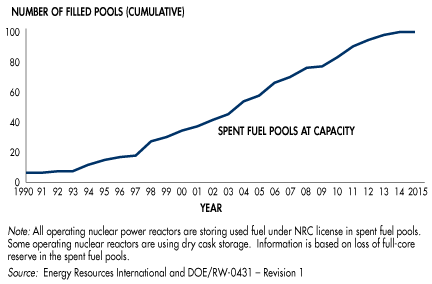
Estimated "wet storage" capacity at reactors, per the NRC. 
Indeed, spent fuel storage at reactors is a growing problem, made worse by the stalemate over Yucca Mountain. Coloring much of the report are concerns over the events at Fukushima, most especially in terms of managing spent fuel pools which are quickly reaching capacity.

Thus, concerns over waste management have begun to intersect with safety concerns, leading to an increase push for "dry storage" of older fuel. The safety concern is somewhat ill-placed, given that only older fuel (generally on the order of 5-10 years following final discharge) can be safely placed in dry storage (as the decay heat of such fuel is low enough to allow for air cooling). The fuel bundles which can be thus moved out of "wet storage" are thus not those at risk of damage in the event of a loss of coolant in the spent fuel pool; rather, any move to remove these bundles has more to do with lowering the total amount of radioactivity in the pool (as well as increasing safety margins in the pool) as well as making room for newer fuel being ejected from the core.

Yet dry storage is neither a substitute for wet storage ("younger", hotter fuel can't go into dry storage) nor a substitute for permanent disposal (dry storage casks, while being suitable for storage on the order of decades or more, is not designed to permanently isolate spent fuel from the environment and is subject to environmental attack).

However, all of this assumes no change from the once-through cycle, where only a fraction of the usable uranium is fissioned and the entire fuel assembly is thrown away with no further recovery of usable materials.

"Buying time" with interim storage

This is perhaps the most glaring flaw in the Commission's report; despite soliciting the testimony of numerous fuel cycle experts (and even in some cases, nuclear energy opponents), the capstone of their recommendations - centralized interim storage - amounts to a rather sophisticated way of simply buying time. In evaluating each of the technical solutions to nuclear waste management, the Commission declined to endorse any, concluding that interim storage leading to some form of geologic disposal is ultimately necessary:
We concluded that while new reactor and fuel cycle technologies may hold promise for achieving substantial benefits in terms of broadly held safety, economic, environmental, and energy security goals and therefore merit continued public and private R&D investment, no currently available or reasonably foreseeable reactor and fuel cycle technology developments—including advances in reprocess and recycle technologies—have the potential to fundamentally alter the waste management challenge this nation confronts over at least the next several decades, if not longer. Put another way, we do not believe that today’s recycle technologies or new technology developments in the next three to four decades will change the underlying need for an integrated strategy that combines safe, interim storage of SNF with expeditious progress toward siting and licensing a permanent disposal facility or facilities. This is particularly true of defense HLW and some forms of government-owned spent fuel that can and should be prioritized for direct disposal at an appropriate repository.
(Emphasis added).

A resonant theme throughout the report is the idea of "keeping one's options open" - in other words, avoiding any irreversible commitment to one technological choice, be it direct disposal or reprocessing. Hence one finds the conclusion for interim storage - a solution which is by its nature temporary. A key problem here however is that temporary solutions, while affording flexibility down the line, are also solutions which leave the issue still unresolved - the very problem which forced this crisis to begin with.

In fairness, the Commission found numerous technical and economic advantages to centralized interim storage, including reducing overall costs for security (especially compared to spent fuel stored at reactors which have been shutdown); the savings in comparison to on-site storage each reactor would make such a site largely self-financing, particularly given the cost of "orphaned" fuel at shutdown reactors. Additionally, centralized storage may afford certain new technical capacities such as mixing spent fuel assemblies in disposal packages in order to "even out" thermal loading in the repository. Finally, an interim storage site could easily be used as a staging area for both reprocessing or as a location to coordinate  final geologic disposal of assemblies.

So where exactly is the problem? The problem is in that this is it. Outside of recommendations for the process of repository siting, this is where the endorsements of technical solutions for nuclear waste management by the Commission end. Hence, the problem. One wonders why it took an entire commission of experts over a year to come to a set of solutions that, while helpful, have been already proposed by nuclear experts (including myself) for any number of years now.


To their credit, the Commission at least acknowledges the connection between interim storage and a credible process for establishing a repository, noting that the two activities cannot simply be carried out in isolation (particularly lest the centralized interim storage site be seen as a de facto permanent site).
Not that Deus Ex...


Yet much of their conclusion, and in particular their reluctance to endorse any of the suite of technological solutions for waste, implies waiting for some form of transformational technology whose technical and economic benefits solve their problem for them. Unfortunately, this is what folks in literature like to refer to as a "Deus Ex Machina" - in other words, a contrivance in which a divine entity swoops in and saves the hero from an otherwise insolvable crisis.

Overlooking incentives

One rather glaring omission in the Commisssion's report is an evaluation of the economic incentives "baked in" to current nuclear waste management policy. As of now, nuclear operators pay a $0.001/kWh fee to the federal government for each unit of electricity produced. While fine in theory (a "polluter pays" arrangement is certainly a forward-thinking way of handling such issues), this overlooks several perverse incentives such a policy produces by using a flat fee arrangement.

First is the linkage between the spent fuel and repository capacity. The overall capacity of a geologic repository is controlled chiefly by temperature - in other words, by the heat being produced by spent fuel rods. This in turn is linked to content of the rods - over the short term (i.e., the first 100 years following emplacement), the primary heat generators are radioactive cesium and strontium, each with half-lives of about thirty years. Thus, after about 100 years, the inventory of these isotopes (and subsequent heat) has decayed to roughly one-tenth of the original content. Over the extreme long-term (i.e., thousands of years), the heat capacity of the repository is controlled by long-lived actinides, specifically plutonium and americium. 

Were these species removed, technical studies have shown that the capacity of the repository could be increased ten to a hundred-fold in the same physical footprint, thereby eliminating the need for additional repositories. Thus, reprocessing spent fuel plays a critical role in such a planning process.

Yet the current fee structure does not charge based on the relative heat content of fuel (or, similarly, volume and total activity). There is thus no built-in incentive for operators to thus seek out ways to minimize these quantities - either through extended on-site storage (i.e., allowing time to do some of the work for them before shipping off waste for disposal) or reprocessing.

Additionally, because the fees are paid as power is generated, rather than when waste is disposed, the cost of disposal has already been "paid for" - and very few utilities (private or public) are so public-spirited as to pay twice for the privilege of waste management (such as paying for the cost of reprocessing fuel).

While uranium and plutonium can be recovered for re-use in spent fuel, reprocessing is expensive compared to mining and enriching new uranium from the ground; estimates show that the cost of raw uranium ore would have to rise appreciably - as much as ten times the current price - to make reprocessing competitive with mining an enriching new uranium. This of course frequently used as an argument by the opponents of reprocessing, but what this fails to account for is the cost of disposal; in particular, it is assumed the cost of disposing of waste is fixed. Yet this assumes after one repository fills, the next will be equally as inexpensive to locate and construct - a rather tenuous assumption. (Additionally, this line of argument neglects the consideration that fuel composes a tiny 10% of electricity costs for nuclear; thus, additional cost premiums for reprocessing are in essence a drop in the bucket.)

An alternative would be a pricing strategy which takes scarcity into account, which charges on the basis of total heat content (and potentially volume and activity) rather than in terms of electricity produced alone. Likewise, charging said fee at the time of disposal rather than immediately would encourage alternative solutions, from reprocessing to interim storage. (The issue of "stranded costs" could easily be handled as reactor decommissioning costs are now, where utilities are required to set aside funds during the operating life of the reactor to pay for its decommissioning and final disposal).

Missing the connection: nonproliferation

An additional point of emphasis in the BRC report is in the connection between the fuel cycle (specifically, waste management) and nonproliferation concerns. Nonproliferation has been (rightly or wrongly) at the fore of nuclear waste management decisions, from President Ford's temporary moratorium on domestic reprocessing, followed by President Carter's permanent shutdown, premised explicitly on nonproliferation concerns.

The BRC report correctly recognizes the linkage between waste management and nonproliferation, in particular the need for multilateral fuel cycle strategies that obviate the need for the spread of sensitive fuel cycle facilities (such as those for enrichment and reprocessing). While the topic of nonproliferation and the fuel cycle easily warrants its own post, in general a U.S. policy of fuel "leasing" (where fuel is enriched and manufactured here, leased to foreign reactors, and returned to the United States for final disposition) can be a vital tool in promoting a more proliferation-resistent fuel cycle cycle.

This argument is explicitly explored in the report; however, what is neglected is that absent a credible, permanent solution for waste, such a "fuel leasing" policy is politically dead in the water. Further, even assuming the development of a permanent repository, it is difficult to conceive of widespread public support for such a policy, given the limited availability of repository capacity.

This would be where the disconnect emerges; in order to credibly advance a fuel leasing strategy (thereby advancing nonproliferation goals), it is highly likely that some form of waste reduction would be required in order to minimize demands upon any given repository. In other words, half-measures such as interim storage are simply insufficient.

Conclusion

The BRC was obviously handed a rather trying and delicate task - trying to untangle three decades of U.S. nuclear waste management policy which had largely found its way into a dead-end. And while many of its instincts are admirable - such as advocating a strategy which is flexible and avoids technological lock-in, this philosophy is taken to an extreme, leading to paralysis in advocating a path forward. Instead, most of what the commission has produced is a call for additional breathing room - itself not bad, but a far cry from the long-term solutions required for spent fuel management.

While a rethought process for siting a geologic repository may fill some of this role, the Commission's reluctance to endorse any technological solutions to waste management (or a clear decision framework for adopting such a technology) is perhaps the report's most glaring shortfall.


Friday, September 16, 2011

Dissecting the BRC report, Part I: Where they got it right

Earlier this week, I gave a summary of the findings of the draft report of the Blue Ribbon Commission on America's Nuclear Energy Future. Several experts have already made their responses to the BRC's recommendations known - both at Brave New Climate and Atomic Insights. While as a relatively new nuclear professional, I lack some of the gravitas of much more established folks, the issue of nuclear waste management and associated policy is of primary interest to me, and thus I wanted to add my thoughts. 

To start things on a positive note, there were many helpful observations made in the report about the over geologic repository siting process (as well as the overall process of waste management policy) which should be highlighted. (To emphasize: even under advanced recycle scenarios, where long-lived actinides are recycled as fuel, some geologic repository will be necessary to handle fission product wastes; however, the engineering requirements would be substantially relaxed, given the shorter time periods for decay.) Thus, this post will focus on some of the highlights where the commission hit upon important, constructive ideas for waste management policy. Future posts in this series will look at where the report fell short.

As an additional aside: ANS is actively soliciting public comments on the entire BRC report for compilation.

A consent-based process 

One place where I am happy to eat (some of) my prior criticisms is in the report's overall emphasis upon a consent-based process for locating a permanent repository site. In fact, much of the analysis in revising the repository siting process focused on a means of engineering a consent-based process, similar to that achieved in Sweeden with the SKB repository; the report also repeatedly emphasized the success of the Waste Isolation Pilot Plant (WIPP, a salt-dome repository for defense waste in southern New Mexico). In particular, the BRC report identifies the importance of state-level cooperation in the waste management process.

The peculiar case of "Salt Vault"

An instructive historical example mentioned in the report is the case of "Project Salt Vault" in Lyons, Kansas in the 1960's. Much of the report's analysis points to the ultimate failure of Salt Vault, due to broad state opposition. However, focusing merely upon the terminal failure misses the greater part of the lesson, namely that community consent is not simply a random force of nature to be contended with, but rather something which can be cultivated with careful work and planning - and very quickly destroyed.

Initially, the Atomic Energy Commission (AEC) was tasked to investigate disposal options for used nuclear fuel. Salt domes offer an attractive geologic disposal option because the existence of salt domes typically belies an area which has been relatively impermeable to water for long periods of time on a geologic scale (e.g., otherwise the salt would simply dissolve into brine). In addition, the heat of spent fuel causes salt to "plastically deform" around the spent fuel casks - in other words, the caverns "heal" around the shape of the container, thus sealing the chamber naturally. Ergo, burying fuel in salt dome formations offers a promising pathway for permanent disposal of intact fuel and long-lived nuclear wastes, as there is reasonable evidence that the formation will be isolated from groundwater, thus securely immobilizing and isolating nuclear waste from the environment.

The story of Salt Vault can be roughly be summed up in two stages. In the initial test phases, the AEC placed great emphasis upon public engagement and consent, contacting local leaders and emphasizing transparency and openness in its operations. During the spent fuel storage test, local citizens were invited to inspect the process and ask questions. Further, and perhaps most importantly, the nature of the test was inherently time-limited. When the experiment was concluded, the AEC removed all nuclear materials from the site, as promised.

The second part of the story picks up in 1970, after fire at the Rocky Flats plutonium facility in Colorado, which set about a chain of events which required the rapid development of a permanent repository for defense waste materials from the nuclear weapons complex. In 1970, the AEC announced - much to the surprise of local leaders - that pending further geological surveys, the Lyons site would be selected as a permanent repository. Unlike the earlier process, local residents and political leaders dug in their heels, and eventually the site was declared to be unfeasible on technical grounds.

What is unmistakable in this example is the impact an open, consent-based process can make. Projects such as SKB and WIPP have been successful precisely because they occurred in a manner which is predicated upon the consent of the local population. In this sense, the BRC report offers helpful analysis for a matter which unfortunately should have been obvious long before now.

Under new management

Likewise, the BRC's recommendations for a federally-chartered corporation (similar to the Tennessee Valley Authority) with dedicated access to the Nuclear Waste Fund also promises to solve other inherent problems which have stymied waste management policy in the U.S. Namely, as of now, waste management operations are a line item in the annual budget; in other words, despite the fact that nuclear operators (and thus ultimately you, the consumer) pay for the cost of disposal in the form of a $0.001/kWh tax on production, the DOE must specifically request funds to manage operations from Congress each year. Which of course means that waste management operations are subject to the whims of politicians, each and every year - including stunts like "defunding" projects mandated by law such as Yucca Mountain and attempting to hijack the repository licensing process through attrition. (Whether one approves of Yucca Mountain as a geologic repository or not - and I think there are better options available - it is still the existing law of the land, per the 1987 amendments to the Nuclear Waste Policy Act, and thus what the administration has done is clearly illegal.) 

The net result has three decades wasted for a $13 billion hole in the ground, in addition to the approximately $20 billion (with interest) that has been collected by Congress but not allocated. Thus, a clear case can be made for a greater degree of overall independence in nuclear waste management operations.

Flexibility in the process

A particular point of emphasis throughout the BRC report is in maintaining a flexible, staged process which easily lends itself to adaptations due to unforeseen circumstances, in marked contrast to the current policy which committed to Yucca Mountain as the nation's sole geologic repository site early on (for reasons of perceived political expediency). A blistering criticism of the current Nuclear Waste Policy Act (NWPA) in the report is in the inflexibility and relative prescriptiveness of the current policy, "locking in" a single solution to nuclear waste management with little flexibility to adapt to new technologies and developments (including both political developments - such as widespread local opposition - and technical developments, such as unexpected revelations in site characteristics). Specifically, the report criticizes the 1987 amendments to the NWPA for failing to account for the contingency that Yucca Mountain should prove untenable.

By contrast, the report's conclusions emphasize the need for a process which avoids "lock-in" - both in terms of policy and technology. Rather, they highlight the need for a phased process which affords maximum flexibility. It should thus come as no surprise, given this perspective, that the report focuses chiefly upon centralized interim storage for fuel (i.e., storing spent fuel in concrete casks in a centralized location) as a medium-term solution for waste management, while options for a geologic repository or other alternatives (such as reprocessing) are evaluated.

Such a strategy bears remarkable similarity to the original NWPA framework (prior to the 1987 amendments), where a second site was to be designated for "monitored retrievable storage" (MRS). The goal of MRS was to provide a medium-term storage location for fuel where it could later be easily retrieved, either for purposes of recovery or for final treatment and disposal elsewhere. In the original framework, an MRS site was not scheduled to be opened until a permanent repository had been located, as to avoid the perception that an MRS site could become a "de facto" permanent repository.

Likewise, the original provisions for the geologic repository prescribed a fixed period of retrievability. However, these provisions were less for purposes of alternative strategies (e.g., reprocessing) as much as the ability to respond to unforeseen technical problems, i.e., should the repository not perform as expected.

Summing it up

Much of the BRC's focus on the process of waste management is important, echoing many of the criticisms waste management experts have made for some time. In particular, nuclear waste management has long been a political problem more than a technical one in the United States (which is not to understate the gravity of the technical challenge). In this sense, the BRC report offers a useful blueprint for the repository process for any future geologic repository process.

Unfortunately, as will be laid out in following posts, this provides little in the means of immediate solutions for nuclear waste management. In particular, the Commission was extremely reluctant to endorse any of the plethora of technical options available for waste management and disposal, instead preferring to outline a strategy for starting over while buying breathing room for the federal government. Most of the practical, immediate solutions for managing spent fuel in the U.S. rely on the concept of centralized interim storage - which while perhaps better than the status quo, is not without its own problems, as will be discussed in the following posts. 

Ultimately, a credible strategy for the entire fuel cycle is necessary for the continued overall acceptance of nuclear energy. While considerations such as economics and safety will always be at the forefront, it is my belief that a credible and technically sound solution for managing spent fuel remains as the last true barrier to widespread public acceptance of nuclear energy, namely because of its current perceive intractability (unlike safety and economics). 

Hence there is a need not only to establish a sound process (which the BRC does a reasonably good job with), but also to begin a process of laying out a commitment to credible solutions - something both the BRC and the federal government have been less forthcoming with.

Monday, September 12, 2011

Hitting the "reset button" on nuclear waste management

In the first of many in a series of posts on "We Read It So You Don't Have To™," I recently reviewed the draft report of the Blue Ribbon Commission on America's Nuclear Energy Future - i.e., the committee tasked by President Obama to devise an alternative path forward in light of the administration's decision to zero-fund the Yucca Mountain geologic repository.

Several nuclear bloggers offered (including yours truly) their thoughts on the draft summary of the BRC recommendations when they were posted back in May. Since that time, the release of the full draft report expands upon earlier BRC recommendations, which largely focused upon centralized interim storage for spent nuclear fuel until a new permanent geological repository can be sited.
While centralized interim storage remains at the heart of its recommendations, a major focus of the full report has been on the process of nuclear waste management policy, including issues of site selection, regulations, and access to funding. Concerns over spent fuel in light of Fukushima also permeate the full report, underscoring the need for an integrated fuel management strategy.


However, in particular, much of the report promotes hitting the "reset button" on nuclear waste management policy, turning the clock back to the 1982 Nuclear Waste Policy Act, prior to the 1987 amendments which designated Yucca Mountain as the nation's sole geologic repository and the decades of scientific and engineering study which followed.

Read the whole summary exclusively at the ANS Nuclear Cafe.