Showing posts with label Fukushima. Show all posts

Sunday, May 6, 2012

Overheated rods & rhetoric

A little knowledge is sometimes a dangerous thing - particularly when fundamentally incomplete technical knowledge is used to make sweeping engineering recommendations. The latest example of this is the concern over the spent fuel storage pools at Fukushima Daiichi Unit 4, which has been getting attention from several corners. First, there was U.S. Senator Ron Wyden (D-OR), a ranking member of the Senate Energy and Natural Resources committee, who recently toured the stricken Fukushima site and released a very widely reported statement that, "things were worse than reported." In particular, Wyden has singled out the spent fuel pools at Unit 4 for unique concern, calling on both the Japanese and U.S. governments to see to it that the rods are safely relocated elsewhere, citing their storage in unsound structures close to the ocean. Wyden has pushed the NRC and others to relocate these spent fuel rods to dry cask storage elsewhere.

As for Wyden's technical credentials for making this assessment? A J.D. in law and his self-assurance in a Senator's unerring technical omniscience.

I suppose it probably doesn't occur to the Senator that relocating spent fuel rods out of the damaged building is no mean feat, given that the rods which will be relocated need to maintained underwater while they are transferred into concrete casks (in this case, mostly for radiation shielding purposes) using heavy cranes. Meanwhile, TEPCO has already reinforced the damaged building, addressing the concern he has over future tsunamis further damaging the weakened building and leading to a release into the environment. Its current plans call to begin removing spent fuel for relocation within the next two years. To emphasize - this is not a problem that relevant technical experts were ignorant of until one brave Senator stepped in and decided to lead.

Of course, to be fair to Wyden, as Dan Yurman points out Wyden is clearly not the only politician suffering from an acute hubris on technical matters.

Overheated rods & rhetoric


spent fuel pool
A spent fuel pool (Image: IEEE spectrum)
At least the good Senator can be forgiven for his enthusiasm however, as it's not nearly as obnoxiously hyperbolic as certain other accounts going around the internet. Anti-nuclear activist and self-described nuclear "expert" (to use the term rather loosely) Robert Alvarez has been shopping around the dangers of spent fuel pools for some time, specifically focusing his ire upon the rods contained in the spent fuel pool at Unit 4. This of course is not a new topic for Alvarez, who has gone so far as to argue that such pools are "a ticking time bomb" and that the U.S. needs to move toward dry cask storage of all spent fuel as soon as possible. (More on why this is silly at best and potentially a dangerous misplacement of priorities in a moment.)

unit 4 spent fuel pool
Spent fuel rods at Unit 4 (Image: IAEA)
Alvarez's latest work, "Why Fukushima Is a Greater Disaster than Chernobyl and a Warning Sign for the U.S.", hits a new low in terms of outrageous hyperbole. Let's start with the headline premise - Alvarez asserts that the potential danger - a release of radioactivity from the spent fuel rods at Unit 4 - is already worse than something which actually happened - i.e., the Chernobyl disaster. (Perhaps aware of this seeming logical contradiction, Alvarez walks this back to "may be worse" in the first sentence.)

The basis of his reasoning? 1) Spent fuel contains very large amounts of radioactivity, 2) The spent fuel pools have been exposed to air (due to the hydrogen explosion at Unit 4), 3) A collapse of building containing the spent fuel pool would lead to an overheating of the rods contained at Unit 4, 4) Somehow, this would lead to a zirconium fire and release all of the radioactivity present in the rods.

Alvarez' blog post is a perfect example of the trouble one can get into when one extrapolates from a small bit of knowledge to a larger technical issue.

Taking it point-by-point - first we have this:
Several pools are now completely open to the atmosphere because the reactor buildings were demolished by explosions;
First of all, it should be noted that spent fuel pools are generally kept at room temperature and atmospheric pressure to begin with. A spent fuel pool, at its core, is essentially a very deep, very large swimming pool (which is also very radioactive as you reach the bottom). At the top, radiation levels are low enough to safely work without problems - you can even look down inside and see the eerily beautiful blue Cerenkov glow if the lights are dark enough. As for containment? The explosion at Unit 4 was in the secondary containment, which is essentially a thin* metal reinforced concrete shell - again, namely because spent fuel rods are un-pressurized and not at the kinds of temperatures found in the reactor. (In other words, the same kinds of phenomena involved in a core melt aren't relevant here.) The primary containment in any spent fuel pool is the water itself, which isn't hot enough to be going anywhere.

*(Edit: "Thin" being relative to the primary containment, which is 4-8 feet thick; most of my understanding of the secondary containment comes from diagrams such as this one, or this one via TheEngineer which bears much greater detail)

Moving on:
As more information is made available, we now know that the Fukushima Dai-Ichi site is storing 10,833 spent fuel assemblies (SNF) containing roughly 327 million curies of long-lived radioactivity About 132 million curies is cesium-137 or nearly  85 times the amount estimated to have been released at Chernobyl. 
So what does this mean? Without context - absolutely nothing. What Alvarez is trying to imply is that in the circumstance that these materials were released into the environment, the consequences would be far worse than Chernobyl. The problem? Alvarez presents no credible physical mechanism for this to happen.

Then there's this:
Also, it is not safe to keep 1,882 spent fuel assemblies containing ~57 million curies of long-lived radioactivity, including nearly 15 times more cs-137 than released at Chernobyl in the elevated pools at reactors 5, 6, and 7, which did not experience melt-downs and explosions.
Why is it not safe? Well, other than the fact that spent fuel is radioactive, Mr. Alvarez doesn't say. An industrial blast furnace is also not a safe place to be, but that certainly doesn't prevent their use. Instead, we actually take precautions to use them safely - the same way spent fuel pools use deep levels of water to both cool the fuel and shield the high levels of radioactivity.

To wit: certainly no one would want to be next to a spent fuel assembly without the shielding provided by the deep pool of water. (With this shielding, the levels of radiation are low enough where it is quite safe to stand above the pool and look down inside - something I have had the opportunity to do before). But for this radioactivity to be truly disastrous (rather than simply being a dangerous but extremely localized nuisance), something has to cause the radioactive materials in the fuel to change state - i.e., to either melt or be carried away ("lofted") by a fire.

In the beginning of his article, Alvarez eludes to the possibility of a zirconium fire, which he asserts could happen if the rods grew too hot. (Alvarez provides no further explanation or reference to credible technical resources beyond this.) Yet there are several significant problems with this theory. First, this would require the rods growing hot enough to ignite (if this is even possible - zirconium in solid form will not ignite, and its melting point is 1852° C). It second assumes that all of the radioactivity is uniformly lofted into the atmosphere; one of the main reasons for the magnitude of the Chernobyl disaster had to do with the fires in the reactor building which lofted radionuclides high into the atmosphere, where they spread across Europe. (Incidentally, this fire was also not from zirconium - it was a graphite fire from the reactor and control rod design being used.)

(Alvarez also rides his hobby-horse in inveighing against spent fuel reprocessing - a topic beyond the scope of this post but one which we've covered previously.)

A background on spent fuel

Spent fuel heat (click for larger)
Meanwhile, let's back up for a moment such that everyone understands what's going on. As we've covered on this blog before, spent fuel does still produce heat after the fission reaction shuts off. The remaining radioactive materials in the fuel, created both by fission and absorbing neutrons - are decaying. The quickest-decaying materials produce very high levels of radioactivity, and much of this energy is trapped in the fuel itself, heating it. Thus why spent fuel needs to be cooled following the reactor shutdown (which was the resulting source of problems at Units 1, 2, and 3).


Both this radioactivity and decay heat fall off dramatically with time, as the shortest-lived fission products decay away. Within 100 days, the heating rate and the radioactivity in spent fuel have dropped by a factor of 10; within 10 years, this drops to 1/100th of the original values.


Spent fuel radioactivity (click for larger)
Doing my own calculations using ORIGEN-S (a tool for nuclear licensing evaluation which is used to simulate spent fuel inventories), a typical assembly of the type found in the spent fuel pool would produce about 3-4 kW of heat after being stored around 1.5 years (and even less as it grows older) - or about 17-20 watts per pin (which themselves are over a meter long). In other words, while fuel which has just been ejected from a reactor poses a challenge in terms of cooling, it is difficult to conceive of how one gets the type of scenario Mr. Alvarez describes, in which something producing so little heat manages to cause these assemblies to melt or spontaneously catch fire.

A solution in search of a problem

Dry storage casks
Dry storage casks for spent fuel
Getting back to the main thread now - let's assume for a moment that this scenario, one already demonstrated to be of extremely questionable plausibility, is true - i.e., that there remains a real threat spent fuel pools, in which the cooling water is lost and the rods subsequently overheat and either catch fire or otherwise change state. So Alvarez's solution, to prevent these rods from overheating? Put them into thick concrete casks cooled by circulating air. Apparently, the same rods at risk of spontaneous combustion when exposed to air are fine if put into thick concrete casks. The logical inconsistency beggars belief.

Note that I am most explicitly not criticizing dry storage - in fact, dry storage casks have been demonstrated to be an effective, medium-term solution for isolating spent fuel from the environment. But to simultaneously assert a danger of spent fuel rods melting when exposed to air while simultaneously advocating to put them in thick concrete casks exposes a basic failure of physics reasoning, one which both Mr. Alvarez's employer and the ever-reliable science reporting of the Huffington Post are happy to embrace.

Alvarez and his sponsors at the liberal think tank Institute for Policy Studies are of course using this reasoning to go a step further, arguing that all spent fuel pools at U.S. reactors are at risk and thus need to be moved to dry storage. Let's just watch the errors compound...

First, let's go back to the decay heat issue. Generally speaking, spent fuel isn't suitable for moving into dry storage until it has cooled for a few years in a spent fuel pool - a general rule of thumb for dry storage is 5-10 years cooling time, although less is possible. The heat generated by 10-year old spent fuel assemblies are a hundredth of that generated by recently-ejected assemblies - in other words it would take one hundred assemblies stored for ten years to equal the contribution of one "fresh" ejected assembly.

If the reasoning here is to give greater safety margins for spent fuel pools in the event of a loss of cooling, dry storage is an extremely inefficient mechanism for doing so - namely because of the fact that the assemblies which are eligible to be moved into dry storage casks make at best a marginal contribution to the spent fuel pool heating. In other words, a large expense for very marginal gains in safety.

So here's how it breaks down: "newer" spent fuel rods are too hot to go into dry storage casks, and thus must be kept in the spent fuel pool to cool. Therefore, the integrity of the spent fuel pool must be maintained. Yet if the integrity of the spent fuel pool is maintained, there is no real safety reason (at least in terms of heat or radioactivity) to move older rods, which can be moved into dry storage. (Note: there are other reasons one may choose to do so - spent fuel pools are limited in terms of total capacity, based on a number of safety-related factors, including total heat as well as how closely the assemblies can be placed together in order to prevent assemblies from going "critical" and restarting the fission chain reaction. However, these are far less limiting circumstances.)

What we have is thus a classic case of a solution in search of a problem. Alvarez (and others, for that matter) have found a solution they like - dry storage - and have (by process of scientifically incomplete reasoning) connected this with a problem they see - the vulnerability of spent fuel in wet storage pools - and naturally put the two together. Regardless, that is, of whether that square peg will actually fit in said roundish hole - the solution is, apparently, to just keep pounding.

When well-meaning ignorance actually becomes dangerous


This is where I think Alvarez's (possibly well-meaning) concern actually becomes dangerous. Maintaining the integrity of spent fuel pools for "younger" fuel is vitally important - which is why some of the most recent changes recommended by the NRC as well as industry call for improvements such as better monitoring and instrumentation at spent fuel pools, along with other kinds of contingency plans to ensure water can be delivered to the pool in the case of a loss of coolant. Likewise, ensuring the integrity in the design of spent fuel pools indeed should be a priority.

But herein lies the problem with "experts" like Mr. Alvarez, who has no actually technical background to speak of - starting with the faulty premise that "wet storage" (i.e., spent fuel pools) can be eliminated entirely (they can't), we are then assaulted with faulty recommendations to move fuel out of these spent fuel pools at large expense and very marginal contributions to safety. Yet arguably these are resources that could be better spent on improvements to the safety of spent fuel pools - things like better instrumentation to know what is going on in said pools and improved emergency response capabilities (such as designing easier means of supplying auxiliary water to the pools). The focus on dry storage as a safety measure thus makes for a dangerous distraction which commits attention and resources away from more productive ends, thus potentially compromising safety as a whole.

Alvarez isn't the only one guilty of a single-minded focus on dry storage as a "solution" to spent fuel storage pools - all kinds of individuals (such as Senator Wyden above, and even some people I know of in real life who should know better...) have jumped all over this. The problem comes down to a simple failure to think things through - again, if spent fuel is too hot to be exposed to air, it's too hot to go inside a thick (thermally insulating) concrete cask. If it isn't too hot for dry storage (i.e., older fuel), then it isn't what is driving the safety issue at the spent fuel pool. Thus, in either case, it's a solution in search of a problem - given the fact that hotter fuel cannot be removed from the pool itself, it is more useful to focus upon the problem at hand.

The underlying pathology here - in other words, why seemingly simple-sounding solutions like this are so seductive - is because it gives the illusion of "doing something" about the (perceived) problem. In this case, this is done through a somewhat primitive technical analogy - we  have a thick concrete containment for the reactor as a safety mechanism, therefore spent fuel should similarly always be in a thick concrete containment. It simultaneously ignores where the solution is technically inappropriate ("younger," hotter fuel) and how it fails to address the root problem (i.e., keeping the spent fuel both cooled and well-shielded - which is done by ensuring the integrity of the water levels in the spent fuel pool). Fundamentally, it is an example of how not to do engineering - engaging in a top-down method of choosing a solution first and making it work to fit the problem.

Under ordinary circumstances, this leads to bad outcomes - wasted money and sub-optimal solutions (or even solutions that are simply inappropriate). In the worst-case scenario, this kind of thinking actually makes things worse, namely by committing time and resources away from evaluating actual safety improvements - and thus where well-meaning concern of outsiders who are fixed upon a particular solution without understanding the actual problem can actually do more harm than good.

Tuesday, February 21, 2012

The other thing Vogtle has revived: Nuclear hysteria

Kitchen sink
They say no one likes a buzzkill, but almost as if on queue, the NRC's announcement of its issue of the first combined operating license (COL) in over three decades has drawn out the usual suspects committed to reassuring us that this both simultaneously meaningless (read, "The Nuclear Renaissance is still dead!") and yet somehow at the same time, an imminent danger. Call it the nuclear equivalent of the "double-tap" - anti-nuclear activists will throw out everything (kitchen sinks included) as an effort to kill off an apparently "moribund" comeback of nuclear energy. The Vogtle announcement seems to have put this process into overdrive.

One probably needs to learn to develop thick skin when working in this field, but sometimes the arguments get obnoxious enough to be called out on their own. Take for example a recent facts-optional anti-nuclear jeremiad published over at The Energy Collective (Disclosure: On occasion my posts are syndicated over there), entitled, "Rethinking the Nuclear Renaissance." The piece is essentially a warmed-over serving of recycled arguments (one can suppose at least that part of it makes it "green"), made somehow new and interesting by the fact that there has been some incremental forward motion on reactor construction in the United States. (But never fear, readers - as our intrepid author assures us, "...only 5 reactors including the two in Georgia that are likely to be completed in the next decade," and yet another of those was one which started in the 70's [Watts Barr] and never completed.)

At this point already one may wish to don their wading boots, because at the risk of falling into the classic XCKD trap, we're about to go debunking.

Monday, January 16, 2012

When the cure proves more harmful than the disease

Recently, the Boston Globe published a series of haunting images taken from the evacuation zone surrounding the stricken Fukushima plants. Perhaps what is most striking is the unearthly nature of the abandoned towns, now turned feral, their only inhabitants being abandoned pets and livestock. These are more snapshots from a post-apocalyptic wasteland; it is difficult to imagine these as bustling, populated places less than a year ago.

Several news agencies have taken up the issue of the evacuation zone, referring to it as "poisoned" and "uninhabitable for decades to come." And of course, taking a look at maps such as that put out by the Washington Post, indeed the situation does look quite grim. (For an excellent, authoritative view of the data, the NNSA has continued to publish updated radiation measurements).

The evacuation zone - and the surrounding dire rhetoric - is founded on the idea of maintain a "safe" level of annual radiation exposure, set as 20 milliSieverts (mSv) per year, or 2 rads/year. (Note that the NRC limits for the general public are 1 mSv/year for the general public, and 50 mSv/year for radiation workers). By contrast, an average member of the public would receive on average 4 mSv/year simply from natural and synthetic sources of radiation each year (including x-rays, CT scans, and the like).

Yet without getting into the issue of radiation hormesis (i.e., the theory that low doses of radiation may show an overall benefit), the epidemiological understanding of radiation risk from protracted exposures at levels under 50-100 mSv is extremely murky. (This is not to assert no long-term risk of excess cancers exists for this level, but simply that our currently understanding of this risk is extremely limited). Conversely, long-term doses above 100 mSv have been shown to contribute to an excess risk of cancers.

Two critical questions should arise at this point. First, what risk exactly is the 20 mSv/year limit based upon? For reference, estimates of radiation doses from smokers put their annual doses around 150 mSv/year (due to polonium-210 deposited into smokers' lungs). While clearly no one should endorse smoking as a healthy life choice, it is regardless a risk that individuals freely make each day at that we as a society (reluctantly) accept. In this sense then, why is the government of Japan making a choices of risk for thousands of displaced individuals at thresholds far lower than individuals themselves accept?

Taking the linear-no-threshold model (LNT) at its face, a common value for excess fatal cancers is assumed to be 0.005 fatal cancers / Sv (i.e., 0.00005 fatal cancers / mSv; the value established by NCRP 115). Assuming a dose of 20 mSv/year, this leads to an overall increase in risk of fatal cancer of 0.03 over 30 years - in other words, 1 in 33 individuals can be expected to develop an excess fatal cancer over a period of 30 years. That comes down to 1 fatal cancer per year per 1,000 individuals exposed - a rate approaching statistical noise.

Still sound scary? Let's put this into the context of other common everyday risks:


RiskOrder (death/year)
Meteorite impacts~0.000000001
Radiation risk to U.S. population from nuclear power plant~0.00000001
Radiation from high-altitude flight~0.0000001
Lightning~0.0000001
Radiation death from consumer products~0.0000001
Flood, tornadoes, or earthquakes~0.000001
Death from cholera or whooping cough~0.000001
Train passenger death~0.000001
Natural background radiation~0.00001
Passenger deaths in aircraft accidents~0.00001
Death from leukemia or tuberculosis~0.00001
Brain damage from whooping cough vaccination~0.0001
Overall road accident deaths~0.0001
Death from bronchitis or influenza~0.0001
Death from childbirth0.00024
Lung cancer risk from smoking (20 cigarettes/day)~0.001
Death from all causes at age 55~0.001
Death from cancer, stroke, or heath disease~0.001
Deaths from 20 mSv exposure (Fukushima exposure limit)~0.001

In other words, the absolute limit on exposure established by the Japanese government corresponds to roughly equal that of the mortality risk of an average smoker (assuming conservative projections of low-dose risk). Beyond this, residents are to be permanently exiled from their homes.

Now conceive of a relatively conservative limit of even 50 mSv/year - a little over double the current exposure limit. From the above exposure maps, this would roughly halve the area requiring permanent evacuation ("permanent" in the sense of on the order of 30 years given the half-life of Cs-137, assuming no further decontamination). This would lead to a risk of about 0.0025 cancer deaths per year - 1 in 400. 

While such a certainly not trivial (although based in conservative projections), the question which should be asked is, "Compared to what?" Those evacuated have been deprived entirely of their livehoods - homes, farms, businesses, and ancestral lands. Clearly, they should be made whole by TEPCO, and failing this, the Japanese government. Yet the additional risk of death from cancer should be balanced against the very real physical and emotional costs of a mass involuntary exodus (not even taking into account the economic consequences for both those impacted and the country as a whole). What is the toll in terms of premature death from stress and associated mental health disorders (including alcoholism, depression, etc.) In essence, what is the cost in terms of human life from a forced exile? 

Nor are forced evacuations without cost - recently, Japan's blanket 20 km evacuation order recently came under fire due to its generic nature (ignoring real-time radiation exposure data, showing that contamination was spreading in a northwestern direction due to seasonal winds). As a result, many individuals received a higher dose than that if they'd simply stayed in place (due to evacuating to the northwest). Likewise, these evacuations themselves necessitated leaving homes (areas where radiation exposure is lower) and taking up residence in less sanitary conditions with greater exposure to the outdoors (increasing overall exposure). Thus, evacuation itself is not without risk. Each alternative must be evaluated for its own inherent risks - there is no free lunch.

I am not about to assert that there is zero risk from allowing residents to return - namely because the data regarding prolonged low-dose exposures is too poor to make a definitive assessment of risk. However, what should happen is that residents themselves should be allowed to make this choice from themselves - rather than the government. Perhaps one of the most disturbing images of the Fukushima evacuation zone is the constant vigil of police forces enforcing the no-entry zone; an act done ostensibly for residents' "own good," despite the legions of family pets and livestock abandoned to starvation or a return to ferity.

Within reason, these are risks residents should be allowed to evaluate on their own in an informed manner, rather than having them imposed upon them.

Saturday, July 16, 2011

An IAEA perspective on Fukushima

I recently had the pleasure to attend a lecture by Randy Beatty (who has been affiliated with the International Atomic Energy Agency [IAEA] for some time), focusing upon the IAEA's perspective on Fukushima, particularly in terms of our current understanding of the sequence of events (which is still evolving) as well as the IAEA's interactions with the government of Japan and TEPCO (the owner of the Fukushima reactors).

Below is a summary of some of the major topics covered, including a more detailed reconstruction of the accident sequence (and particular, both the relatively small timeframe in which most of the damage occurred) as well as a better understanding of how other, secondary complications such as the hydrogen explosions came about. Finally, more precise estimates of the quantities of radiation released and the direction of its spread shed some light on how many were affected and the relative appropriateness of certain evacuation precautions.

Accident sequence

The "main" narrative of the Fukushima incident is relatively understood, summarized as follows:
  • Following the 9.0 earthquake, each of the reactors was shut down, halting the fission reaction
  • Backup power from diesel generators came online to operate coolant pumps to remove decay heat from the reactor until these were wiped out by the incoming tsunami; 
  • Battery backup power came online to operate these pumps until such power was depleted
  • Water inside the reactors began to boil away as it heated up.
  • As water boiled away, the fuel rods heated up.
  • Water interacted with the extremely hot zirconium cladding, producing free hydrogen (which lead to the hydrogen explosions)
  • As the fuel rods heated up, the cladding failed, releasing radioactive fission product gasses. The fuel is also believed to have partially melted when it became uncovered by water, releasing more radioactive materials from the core.
  • Cooling was restored by injecting seawater into the reactors to quench the decay heat from the rods and prevent further melting.
What has been perhaps less well-understood are issues such as how much fuel melted, how long the core was not covered by water, and the extent of the radioactive release. A great deal of research work is being conducted at the national laboratories presently to reconstruct what was going on inside the reactors in the first few hours (immediately after the rectors were shut down) in order to characterize what exactly happened; thus our understanding on this point will continue to evolve over the next several years.

One of the key issues that seems relevant in much of the accident sequence is the relative speed at which events progressed. While most of the world witnessed the event as a long, drawn-out drama, much of the damage had already occurred in the first few days (and in particular, the several hours the reactors were without power before seawater injection was applied). 

Courtesy of Randy's presentation, here is a good timeline of what occurred at each reactor.

Unit 1
  • March 11, 2:46 PM: External power lost, emergency diesel generators begin to supply power
  • March 11, 2:52 PM: Emergency cooling systems (isolation condenser) started
  • March 11, 3:37 PM: All AC power lost
  • March 11, around 5:00 PM: Fuel exposed, core melt begins
  • March 12, 5:46 A.M.: Begin of freshwater injection from fire extinguishing line
The fuel was estimated to have been uncovered for about 2.5 hours. Water injection was estimated to have stopped (due to the loss of power) for 14 hours and 9 minutes. 

Unit 2
  • March 11, 2:47 PM: External power lost, backup diesel generators start up
  • March 11, 2:50 PM: Emergency cooling system (Reactor Core Isolation Cooling system - RCIC) starts up
  • March 11, 3:11 PM: All AC power lost
  • March 14, 1:25 PM: RCIC operation stops
  • March 14, around 6:00 PM: Fuel exposed, core melt begins.
  • March 14, 7:54 PM: Seawater injection from a fire extinguishing line begins
Approximately 30% of the core of Unit 2 was estimated to have been exposed in the 6 hours and 29 minutes in which cooling was unavailable.

Unit 3
  • March 11, 2:47 PM: Loss of external power, start-up of emergency diesel generators
  • March 11, 3:05 PM: Startup of emergency cooling system (RCIC)
  • March 11, 3:41 PM: Loss of all AC power
  • March 12, 11:36 AM: RCIC stops due to loss of power
  • March 12, 12:35 PM: Startup of HPCI (high pressure core injection) system as a backup cooling measure
  • March 13, 2:42 AM: Stop of HPCI
  • March 13, around 8:00 AM: Fuel exposed, core melt begins
  • March 13, 9:25 AM: Startup of freshwater injection into core from a fire extinguisher line
The fuel thus appears to have been exposed from approximately 1.5 hours, with water injection having been unavailable for about 7 hours.

What this means

Several issues are clear from this timeline of events. First, despite an earthquake beyond the design basis for the reactors, emergency systems largely functioned as intended. Were the backup power systems not destroyed by the following tsunami, it is likely the incident would have largely been contained without incident; indeed, it was the "total station blackout" condition which was the root cause of the radioactive releases (i.e., by allowing the fuel to overheat). In this sense, one criticism made of the Japanese government was in its initial reluctance to accept assistance from outside agents such as the United States, which had offered to airlift in replacement generators when the tsunami destroyed the initial generators. Whether this initial refusal was a face-saving measure or something else remains to be seen, but quite clearly this exacerbated the issue.

The loss of emergency diesel power systems was near-total due to the tsunami; a total of twelve diesel generator units were present at Units 1-6, of which all but one at Unit 6 were wiped out. (This remaining unit was elevated above the tsunami.)

Backup systems such as battery backups appear to have mitigated some of the damage, particularly in the case of Unit 3, where Japanese officials report that the battery backups appear to have lasted approximately 50% longer than their design life (around 18 hours, compared to a design life of 12).

Most stark here is the relatively short time period in which most of the damage occurred - in most cases, the fuel was exposed for only a few hours (up to about 6.5 hours for Unit 2, which experienced the most severe fuel damage). Likewise, following the complete loss of power, it took only a few hours for the core to become uncovered due to water boiling from the core.

Complicating the situation at Unit 2 may have been the hydrogen explosion which occurred in the suppression pool (the donut-shaped cavity at the bottom of the reactor, designed to condense steam from the reactor to recirculate coolant and draw off heat). This appears to have accelerated the damage at Unit 2, explaining the extent of damage seen there.

Finally, most of the radioactive release appears to have occurred within the first three days, following the uncovering of the fuel in the cores of Units 1-3. Due to extremely difficult conditions at the reactors from the earthquake and tsunami (i.e., extreme devastation and an overall lack of electricity, with no instrumentation information from inside the reactor buildings), the overall extent and significance of radioactive releases would not be ascertained until later.

Spent fuel pools at Unit 4

Condition of spent fuel in the pool

Unlike Units 1-3, Unit 4 was in a scheduled outage for refueling and maintenance prior to the earthquake. Rather, Unit 4's spent fuel pool contained a mixture of older and newer, more recently-ejected fuel (which is hotter, due to a greater amount of short-lived fission products remaining in the fuel).

The loss of power to Unit 4 produced a similar situation to Units 1-3; even though the fission reaction is "off" in the fuel, short-lived radioactive materials in the fuel continues to decay, generating heat. This heat must be removed from the fuel, thus fuel is stored in deep pools of water, generally kept around room temperature and pressure. (In other words, spent fuel pools are quite similar to very deep swimming pools for spent fuel rods). The water serves a dual purpose; first, the water "wicks" away heat from the rods, keeping them cool, and second the water provides an effective shield from radiation emitted by the spent fuel. 

Heat in the cooling pool must be removed, just as is the case of reactors - thus cooling pumps exist to circulate the cooling water in order to maintain the temperature of the pool (and thus the spent fuel). Thus, should these pumps be disabled (due to a loss of power), this water will begin to heat up as well, eventually boiling. However, spent fuel in the pools is generally much cooler than that from fuel in reactors which have just shut down - recall that decay heat falls off exponentially with time, meaning that after a few weeks, the heat emitted by spent fuel rods is much, much lower than that of a reactor which was just shut down. Thus, the loss of coolant would be much slower than that of Units 1-3.

During the crisis, some speculated based upon limited data (little to no actual instrument data from the pool was available due to the lack of power) that the water levels have precipitously dropped; NRC Chairman Gregory Jaczko even (now infamously) speculated that the pools had gone "completely dry."

However, recent images taken of the spent fuel in Unit 4 by the IAEA indicate that the fuel appears to be intact and undamaged; thus an uncovering of the fuel in Unit 4 appears to be extremely unlikely.

Fuel stored in the spent fuel pool at Fukushima Dai-ichi Unit 4. (Image credit: IAEA
In addition, the IAEA has tested for radioactive isotope concentrations in the water within Unit 4's spent fuel pool; in the event that the fuel became uncovered or fuel melted, telltale isotopes would be present to indicate this. Current analysis has failed to find these, further indicating that it is unlikely fuel was damaged at Unit 4. Finally, experts familiar with fuel chemistry indicate that radioactive ruthenium (a chemical in the lanthanide family and a common fission product which tends to travel with water) would have been present outside Unit 4 had fuel melt occurred, which has not been found.

However, the drop in the water level which occurred in Unit 4 is still an unknown (due to the lack of instrument measurements inside the building from the power outage) and difficult to determine; experts are currently attempting to perform back-calculations to estimate this.

Source of the hydrogen explosion

One source of speculation and debate was the hydrogen explosion which occurred at Unit 4, in particular how a hydrogen buildup could have occurred in the outer containment building around the Unit 4 spent fuel cooling pool. The presence of hydrogen is a clearly worrisome sign, implying that a sufficient amount of water has either boiled off or leaked to allow the fuel to become uncovered and grow hot enough to enable the hydrogen production reaction. (Fuel which is covered by water cannot get hot enough to allow the reaction between water and the zirconium clad to occur; therefore, the production of massive amounts of hydrogen would imply an uncovering of the fuel.)

Thus, the hydrogen explosion at Unit 4 lead some (such as Jaczko) to speculate that the spent fuel pool had gone "completely dry." However, no signs of fuel damage were observed, indicating that zirconium hydriding from spent fuel rods in Unit 4's pools was extremely unlikely.

Therefore, where did the hydrogen in Unit 4 come from? The IAEA believes that hydrogen may have been vented from Unit 3 to Unit 4 through a "standby gas treatment system" exhaust pipe; this exhaust tube had joint inputs from Units 3 and 4, thus conceivably allowing hydrogen to travel from Unit 3 (where it was being produced following the core becoming uncovered) to Unit 4 (where it subsequently ignited and exploded).

(Left): Standby pipe from Units 3 and 4; (right) Enlarged view of junction (Image credit: IAEA)

Releases of radioactive materials

Thanks to my colleague Alan's ability to read and speak Japanese, this blog has been following dose data around the plant and surrounding area from early on after the accident. However, the IAEA has helpfully compiled a map of further measurements which were taken by ground stations and measurements by aircraft.

Map of air dose plume release from Fukushima. Red: 9-91 microSv/hr,  Orange: 9.5-19 microSv/hr, Yellow: 3.8-9.5 microSv/hr, Green: 1.9-3.8 microSv/hr, Blue: 1.0-1.9 microSv/hr, Indigo: < 1.0 microSv/hr (Image credit: IAEA)
Air measurements conducted around the area of the plants indicate that much of the plume containing radioactive materials traveled northwest (i.e., due to wind); doses outside the main plume spread to the northwest were found to be relatively negligible. Likewise, with the exception of the plume "tail" in the northwest, nearly all of the elevated dose rates in air were concentrated within a radius of 30 km from the plant, calling into question the logic of NRC Chairman Jazcko's order for Americans within 50 miles (around 80 km) to evacuate.


Evacuation areas around Fukushima. (Image credit: IAEA)
As is clear from the evacuation zone map, the Japanese evacuation order of 20 km with a deliberate evacuation of Iidate and Katsurao prefectures appears to be based upon a sound evaluation of the measured exposure rates. Additional precautions in place (e.g., staying indoors and prophylactic measures such as distributing potassium iodine tablets) were implemented in areas within the 30 km radius.   

Approximately 78,000 people were evacuated from the evacuation area (20 km), with an additional 10,000 evacuated from the "deliberate evacuation area" to the northwest (a smaller number due to the relatively low population density in these areas). Residents in the "Evacuation prepared areas" were informed to stay indoors and prepare for a potential evacuation order in the event of further emergencies (e.g., large measured increases in the exposure rate).

Preventative measures

As a precautionary measure, potassium iodine (KI) tablets were distributed to residents within 50 km of Fukushima prefecture; 1.51 million potassium iodine pills were distributed to approximately 750,000 residents , while 6,100 grams of KI powder was distributed to 120,000-180,000 individuals. 

Potassium iodine is an effective preventative measure for exposure to radioactive iodine (I-129 and I-131) if taken prior to exposure. Iodine is readily taken up by the thyroid; thus, by flooding the body with stable iodine, any radioactive iodine ingested (due to groundwater and air transport) would be excreted out of the body before being absorbed. (Conversely, radioactive iodine is frequently used for the treatment of thyroid disorders, given that the radioactive dose can be easily targeted specifically to the thyroid.)

Evacuations and relative risk 

A point which must be emphasized again in evacuation decisions such as this is in the relative risk averted through evacuation versus the human costs imposed, particularly in light of an epic natural disaster such as this, with tens of thousands dead or missing and over a hundred thousand displaced. Overly conservative evacuations based upon marginal risks (i.e., outside 20-30 km) place an additional burden upon already strained emergency resources (shelters, medical facilities, etc.) while giving little additional benefit. Even under the best of circumstances (which clearly was far from the case here), broad evacuation orders can result in tremendous hardship; the gains from evacuation must therefore be balanced against the additional burdens imposed.

Relative amount of radioactivity released

Based upon calculations made of the measured activity outside the reactors, the IAEA made an estimate of the relative fraction of material released from each core. Nearly all noble fission product gasses (such as xenon and krypton) were released; however, these are of negligible concern, given the fact that they are chemically inert. Approximately 1% of radioactive iodine was released from Unit 1, with about 0.4 to 0.7% of the iodine released from Units 2 and 3. Finally, for other species (including cesium), less than 1% was determined to have been released into the environment; for Units 2 and 3, this was determined to be around 0.3 to 0.6% of the activity in the core.

Estimates as to the total activity released to the atmosphere put the activity of I-131 released around 1.5 to 1.6x10^17 Bq (one becquerel is one atomic decay per second), and around 1.2 to 1.7x10^16 Bq of Cs-137. (Note that not all of this activity was spread inward; large amounts of this release were likely dispersed over the ocean, where they are greatly diluted.)

Presence of transuranic elements 

One rather persistent rumor among media outlets and particular blogs was reports of transuranic elements (i.e., plutonium and other elements above uranium on the periodic table) being found in soil samples outside the plant, indicating a "blowout" of materials from the core similar to Chernobyl. (in the case of Chernobyl, the resulting fire lofted much of the fuel materials into the air, scattering them much farther than they would have otherwise traveled and allowing heavier species, such as plutonium, to escape).

The IAEA did find reports of small amounts of transuranic materials found near the plants from ground monitoring stations and groundwater samples, however these measurements were found to be inconsistent, with little sustained evidence. One difficulty is establishing a source for these materials, which are not necessarily from the plant itself, given the widespread dispersal of radioactive elements around the globe during the time of above-ground atomic testing. Testing for aspects such as the relative abundance of different isotopic species may help to determine the source (i.e., whether the material is older, such as from bomb testing, or newer), however given the relatively scarce amounts found, it has been difficult to establish a source for these materials, given that they conceivably may have precipitated from anywhere in the area.

Worker and resident doses received

Estimating doses for workers was found to be extremely challenging, due both to the lack of instruments at the facility (from the power outage) as well as the flooding, which either swept away or ruined many of the personal dosimetry meters worn by workers or stored at the plants. Of 7800 workers measured, the average worker dose was about 7.7 microSv (well short of the yearly dose limit); 30 were found to have doses greater than 100 milliSv, while 2 workers were found to have equivalent doses to the skin of about 2-3 Sv (due to contact with radioactive water in flooded buildings, causing minor skin burns similar to a sunburn).

Estimation of doses received by the public was measured primarily by the level of surface contamination (i.e., number of radioactive counts per minute). Most of the 195,354 individuals screened were found to be below the 100,000 counts per minute limit; of those who were found to be above this limit, most of these individuals had residual contamination on clothing only and were cleared after changing clothes and vigorously washing their skin.

Accident classification

One question which came up was in the choice (and chronology) of the accident classification of the Fukushima incident, initially placed as a "3" on the INES scale and moved to a "4," then a "5" (similar to Three Mile Island) and then finally upgraded to a "7" (similar to Chernobyl).
INES accident classification scale (Image courtesy of IAEA) 

With respect to the accident classification, the choice of a classification of "7" (the most severe accident category classification) seems somewhat confusing in light of the limited consequences of Fukushima compared to Chernobyl (whose overall total radioactive releases were nearly ten times that of Fukushima). However, the accident classification itself was based upon the total activity of materials released (e.g., very short-lived materials, while quickly going away, will have a higher relative activity rate), including those released into the ocean (where the effect would be relatively dilute). Thus, the application of a "7" rating was a strictly mathematical decision, based on the threshold value for total release.

On the other hand, the sequence of classifications was a more delicate political matter. As evidence surfaced of the situation growing more severe, TEPCO and the Japanese government were continually required to update the accident classifications. (Likewise, there appeared to be a certain reluctance on the part of TEPCO and others to disclose the full significance of the incident). As the situation progressed, it was clear that TEPCO and others would simply need to concede the severity of the conditions, re-classifying the accident as a "7" in order to "get ahead" of the situation, rather than being seen as continually dissembling[?] and delaying. In as much, while the final classification itself was based upon total measurements, in the IAEA's view the chronology of how these ratings were assigned as the accident unfolded were influenced by concerns over public perception.

Plans for improvements


Much of what will occur in the aftermath of Fukushima will be to determine how nuclear operators can plan for and respond better to similar circumstances in the future. Much of the problems encountered at Fukushima came from the total loss of power at the facilities, followed by the destruction of the backup diesel generator units in the tsunami (a condition known as "station blackout," the worst possible circumstance which can occur at a plant).


Thus, many of the IAEA's recommendations fall under these categories. In addition to recommending that operators and plant designers harden facilities against earthquakes and floods, a key area of focus will be in ensuring that reliable backup supplies of power can be maintained in order to operate cooling pumps following an unexpected plant shutdown. This includes hardening backup generators (placing them out of reach of flood waters) and making dedicate contingency plans such as mobile power vehicles to supply power in the case of a generator failure.


Other factors include features such as means to mitigate hydrogen production in circumstances such as this, through the installation of hydrogen "recombiners" (which steadily burn hydrogen rather than allow it to accumulate) and dedicated "blow-out" panels to allow for emergency venting of hydrogen from the outer containment buildings. It was noted that over 300 metric tons of hydrogen was produced in the three reactor units (in other words, over 300,000 kilograms), thus leading to the rather dramatic hydrogen explosions witnessed.


Other recommendations focus upon measures for emergency response, such as procedures for handling nuclear emergencies. A particular complication in the case of Japan was in the widespread devastation beyond the scope of the plants themselves; many workers at the plant were uncertain about the safety of their homes and families, leading to confusion and initial difficulties in maintaining sufficient staff levels to respond to the emergency at the plants.


Proposed safety systems upgrades (click for larger version; image credit: IAEA)

Finally, the IAEA recommends regulatory reforms such as instilling a more thorough safety culture and reinforcing the regulatory safety infrastructure by fostering a greater separation of regulators and utilities, which have been frequently criticized for enjoying too cozy of a relationship in Japan. An additional criticism made was in that preservation of economic assets (e.g., the reactors) was potentially prioritized above safety in the early stages of the response, delaying such measures such as seawater injection (an emergency measure to cool the core which almost certainly would mean a total economic loss for the reactor unit).


Final thoughts


Nuclear safety is a constantly-evolving process; the events at Fukushima will undoubtedly be studied by engineers and scientists for years to come in order to develop better safety features and response techniques to ensure maximum possible safety to the public. To some degree however, there comes a point where one plans against the essentially unpredictable (for example, a record earthquake and tsunami); thus, not every measure can simply be preventative in nature, but rather in how to respond to and mitigate such events. (Examples of this include hardening backup generators and designing robust containment buildings to prevent radioactive releases.)


It likewise is useful to place events like this in context; while it is clear that Fukushima was an extremely serious event in hindsight (it would now appear to be far more serious than Three Mile Island, although less serious than Chernobyl), the consequences must be compared to the risks encountered by the available alternatives. For example, one consequence of the earthquake was the destruction of a hydroelectric dam, destroying over a thousand homes. Liquefied natural gas facilities were also destroyed in the earthquake, leading to further casualties. By comparison, the only person who has died as a result of the Fukushima disaster was not even killed by a radioactive release, but rather was killed by a falling crane.


Risk is an unfortunate fact of life, and in particular of energy production. This applies to all forms of energy production, not just nuclear - each form of energy production comes with equivalent risks and trade-offs, including economics, pollution (for example, the radioactive releases from coal plants in smokestacks are far higher than that of nuclear plants), land utilization (diffuse energy sources such as solar and wind consume enormous land footprints), etc. There is, alas, no "free lunch" when it comes to energy. The best that we can hope for is to understand and minimize risks by constantly striving for better and safer designs and better ways of responding to accidents.


In particular, it is worth noting that the Fukushima plants were of a prior vintage - built in the 1960's and nearing retirement. Newer plants built at Fukushima Dai-ini did not suffer nearly the same consequences as those at Dai-ichi, in part due to enhanced safety features within the designs. Likewise, plant designs being proposed today take advantage of decades of engineering experience, including advances in technology (particularly in advanced computing - perhaps the most amazing thing about much of the existing nuclear fleet is that it was designed with pencils and slide-rules...). New designs such as small modular reactors promise further enhancements in safety.


Ultimately, safety will be an ongoing challenge, one not entirely technical in nature. After Three Mile Island, one of the most radical changes to the U.S. nuclear industry was a focus on human factors - particularly looking at aspects such as instruments in the control room, operator training, and instilling a safety culture. Similar lessons may ultimately have to be internalized in the case of Japan.


It has often been said, "Experience is the harshest teacher, and her lessons the most expensive." For the Japanese, no doubt this case is little different.


A special thanks to Randy Beatty and the IAEA for both presenting and making these resources available to me.

Thursday, March 24, 2011

Recent presentations on the events at Fukushima

Each of these presentations was designed to engage and inform the general public about the events which have occurred at Fukushima, including a specific explanation of what we understand to have happened so far from the perspective of experts and ultimately what is being done now to bring the situation under control. The advantage of these types of seminars is that the offer the ability to convey more detailed explanations of the specific sequences of events that lead to the current situation which are typically not available in traditional media accounts.

Wednesday, March 23, 2011

Update on Dose Readings in Japan

This is a quick post to summarize the newest and best things on the new I have my hands on to assess the state of the dispersion of radioactive gases from Fukushima I.

Best Sources of Understandable Information

Firstly, a great new blog called Where are the Clouds? They are doing a fantastic job of following the new developments and actively contributing to the body of knowledge regarding dose rate readings and atmospheric plume modeling in the wake of the disaster. These are the professionals.

A fantastic new graphic has appeared showing the plant site dose readings from the start through the "hottest" (radiological) days at the site. You can probably read this graph for half an hour. Credit to R.C. Hoetzlein, and many thanks for releasing it for all uses. There are still a few issues related to the units and comparisons, but otherwise amazing.


Tepco reorganizes monitor readings

I imagine it's hard for reporting offices to navigate the incredibly disjointed press releases coming from Tepco. A few days ago, they were in the main list of press releases on their home page. But then they moved it to a new page of releases of nothing but monitor readings specific to the plant. I had been coming back to the NYTimes graph for what the site readings are now giving, but it seems they stopped right about the time Tepco moved the page.

Maybe they never got the memo. Or maybe they became bored of it. The most recent graph I see now is still a few days old, but as I've looked at the reports, not much has changed. On top of that, Tepco has released local area data that the NYTimes has graphed fairly well (this covers a lot of Fukushima Prefecture). Additionally, Tepco has updated this information over time, which gives a little bit more interesting picture than the confusing site readings.

Of course, there is still bad information out there. The NYTimes published a map supposedly showing the dose rates at different radii from the plant, which would seem to any ordinary reader to predict nausea, vomiting, and hair loss at 5 miles away from the plant. The only problem is that it was made with no information specific to Fukushima I, aside from an assumption that fuel was failed, core melt occurred, containment was breached, etc. It's hard to identify just how wrong this graph is, because it doesn't even give enough information to know (i mean, exposure time). Thankfully, other bloggers have been identifying this as a misuse of a model from an old and otherwise well-intentioned paper. And anyway, to get an idea of what doses people in Japan are facing, you can just keep reading.

What is Happening to Dose Rates in Japan?

Note, in order to convert to Japan time right now, switch am and pm, then add 1 hour. To convert back to EST, switch am/pm and subtract an hour.

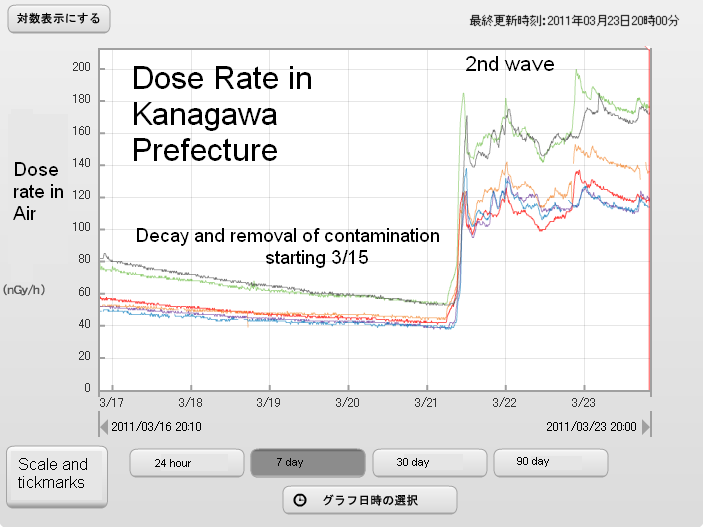
There have been 2 major onsets of radiation spread over areas to the southwest of the Fukushima Daiichi plant. The first was very early on Tuesday 3/15 (Japan time). I've gone back and plotted the dose rates in Ibaraki Prefecture monitoring stations to compliment the previous graph I posted.


Note that this is in log scale now. Ibaraki Prefecture is much closer to Fukushima than Tokyo and correspondingly has much higher dose rates, and yes, will have greater long term effects as well. Fukushima Prefecture, of course, is hit harder than any other. Let's return to Tokyo. How have things changed there? A second wave of artificial radiation has clearly appeared. The following shows the dose rates as the first and second major Southwest winds pushed the plume over the Tokyo area.


One can easily identify the two transit dates the plume made through Tokyo. One is 3/15 in the morning and another is 3/21 in the morning. For 3/15, atmospheric data shows a line going straight through the Tokyo area, which is expected. If that wasn't enough evidence for you, the wind patterns at all altitudes on 3/21 and 3/22 show the plume traveling toward Tokyo and even further.

Mindblowing Analysis from the NNSA

Last post I was praising the public data feed from Japan's national network of detectors. The US, of course, has some impressive technology itself, and the DOE has come out with this bombshell (download in pptx format). The tool is called the Aerial Monitoring System, and obviously they send a plane around that constantly takes readings and quickly flies back and fourth over an area to get an incredible map of dose readings.


These images are showing a local perspective (left) and larger perspective (right). You can see the path the craft takes in the lines that are shown. They show units of mR/hr. For many kinds of radiation, 1 R= 1 rad = 1 rem. 1 rem = 0.01 Sv, and the limit for radiation workers in the US is mSv, or 5 rem (equivalent dose). The red color in the graphs indicates 12.5 mR/hr, and if this was absorbed for a day, that would be 0.3 R, and the equivalent dose (adding extra weighting for more damaging particles) would be some amount more than that.

Without getting into specifics, a 12.5 mR/hr area should really be avoided to whatever extent possible, but there should be differences between the readings from the air and the dose on the ground. Either way, the most important thing to avoid is internal dose. There is no reason to panic. The Japanese authorities have been making decisions to tell people not to eat certain farm products among other measures, these are all reasonable as far as I can tell but firmly based on the precautionary principle.