Showing posts with label dry storage. Show all posts

Wednesday, January 16, 2013

DOE's spent fuel strategy: Not a bang but a whimper

There is a hallowed tradition in Washington known as the "Friday Document Dump," in which news and announcements the government wishes to bury are strategically timed for Friday afternoons, when such announcements tend to fall through the cracks of the typical news cycle (i.e., assuming reporters are even present to cover the event, the strategic timing tends to ensure it will miss the weekend papers, thus effectively "burying" the story by the time the new week rolls around).

DOE SNF strategy wordle
In this storied tradition, the Department of Energy released the Obama administration's response to the Blue Ribbon Commission report last Friday to relatively scarce media coverage. In fact, one would be hard-pressed to find any coverage in many of the major papers; what little coverage there was can be found in the Washington Times, Platts (an energy publication), and the Las Vegas Review-Journal. (Needless to say, the timing appears to have had its intended effect).

AREVA's NextEnergy blog and Nuclear Diner have already posted some of their thoughts on the release, but after reading the DOE's report I have to say I've felt a bit underwhelmed. As a friend remarked, it's a document "laying out the next set of milestones for the nation's spent fuel management program to miss." I wish I could say he was joking.

Some of the major highlights:
  • An emphasis upon a flexible, staged, consent-based process for locating a permanent geologic repository for used nuclear fuel designed to be adaptive to potentially changing circumstances.
  • A new, independent waste disposal organization charged with overseeing used fuel management and disposal, along with legislative action to reform allocation of the Nuclear Waste Fee paid by operators to allow for greater operational flexibility and independence.
  • Short-term emphasis upon siting a pilot interim storage facility for used nuclear fuel, with a triage priority of relocating fuel from decommissioned reactor sites first. Operations would begin in 2021.
  • Transitioning toward an operational interim storage site with sufficient capacity to meet the existing federal government's liabilities under the Nuclear Waste Policy Act of 1982; operations to begin in 2025.
  • Making "demonstrable progress" toward locating and characterizing a potential geologic repository with a target operations date of 2048.
Copy Pasta
Much of the above points are relatively familiar, essentially retreading what has already been detailed in the original BRC report findings (thus begging the question of why a 14-page response would take so very long). And, for the most part, the BRC findings, translated to the DOE report, are not bad findings - however it's hard to find where the DOE's report has added much at all to the discussion aside from a blanket endorsement.

Perhaps to the disappointment of the AREVA (who emphasized reprocessing as a viable fuel cycle strategy in their blog response), the report seems to go out of its way to minimize the potential role of reprocessing in a future U.S. fuel cycle strategy - in fact, one point which stuck out to me was in that the DOE report recommended that the scope of the waste management organization (referred to as a "management and disposal organization, or "MDO" - because if there's one thing Washington loves, it's acronyms...) should be explicitly constrained to explicitly exclude reprocessing. Here's the relevant quote:
In addition, the mission of the MDO will need to be carefully defined. For example, funding made available to the MDO should be used only for the management and disposal of radioactive waste. While this could include the management and disposal of waste resulting from the processing of defense materials, the MDO itself should not be authorized to perform research on, fund or conduct activities to reprocess or recycle used nuclear fuel. These limitations on the MDO mission are consistent with the recommendations of the BRC.
Thus, it would strongly indicate a commitment to a once-through fuel cycle for the time being. Among other factors cited to support this decision was ORNL research I'd highlighted in my previous post, which indicated that most of the current used nuclear fuel inventory (98%, in fact) could be consigned to direct disposal even assuming a future closed nuclear fuel cycle.

With respect to the emphasis on interim storage, I have to admit to having a somewhat adverse reaction while reading the report - namely because of the jarring disparity between words and deeds. In particular, such a ready-made pilot facility for interm storage based upon local consent has already been proposed - Private Fuel Storage. PFS existed as a consortium of nuclear utilities; it negotiated a contract with the Skull Valley Band of the Goshute Indian Tribe located in Utah (located about 70 miles SSW from Salt Lake City).

PFS had been attempting to open a privately owned and operated interim storage site for over ten years (it first filed a license application with the NRC in 1997); in the process, it has been a political football of multiple administrations in the ongoing battle over Yucca Mountain. Ultimately, PFS received an operating license from the NRC in 2006, yet various shenanigans from both the state and federal level prevented it from ever opening. (The Bureau of Land Management refused to allow for the expansion of a rail line to ship fuel to the reservation, and the state of Utah continued to block any shipments of spent fuel canisters to the site along Utah highways. Despite the fact that as a Native American tribe the Skull Valley Band is legally autonomous from the state of Utah, the state government found plenty of other ways to frustrate the intentions of the Goshute Tribe and PFS.) 

Roughly two weeks before the DOE report was released, PFS finally announced its intention to withdraw its license from the NRC - namely because it was clear that the process was going nowhere (and licenses aren't free). Thus, a jarring chasm between word and deed - clearly, a pilot interim storage site already existed - one which had the consent of the local government (in this case, the Goshute Tribe); however, the Obama administration has shown little inclination to intervene. One is left to wonder then how any other future site could hope to get off the ground when a ready-made solution such as this one is abandoned to state-level sabotage; one can easily see such a scenario playing itself out with states blocking shipments to interim sites located outside their borders based on the Utah example.

Particularly depressing about the overall strategy is in its relative lack of ambition; a planned operating date for an interim storage site which would happen a mere 27 years after the original timeline obligated by the Nuclear Waste Policy Act (and 43 years after the act was first passed), with no repository in sight until I (a relatively young and spry individual at the present) am poised to retire - a full 50 years past the original deadline. (Only in the federal government is one allowed to miss a deadline by a full half-century with a straight face.)

I will be the first to say that the 1987 amendments to the Nuclear Waste Policy Act which ultimately decreed Yucca Mountain as the nation's sole geologic repository by virtue of legislative fiat was a mess. But the warmed-over copy-'n'-paste job combined with completely lackluster goals for siting a repository look like rather unseemly indicators that Obama administration's approach to the BRC process was essentially that of a stalling tactic, following their contentious decision (both politically and legally) to cancel the Yucca Mountain project. If one is to unilaterally dismantle nearly three decades of standing policy of nuclear waste disposal policy, a little more should be expected in terms of an alternative. The DOE report would not be it.

Monday, December 3, 2012

Yucca Mountain is dead. Long live Yucca Mountain!

Last October, during the Republican primaries, I made a prediction regarding the future of Yucca Mountain - namely, don't bet on it. Not, of course, because it's particularly deficient on a technical level (it's not perfect, but you can judge the science that went into it for yourself.) But rather, the battle for Yucca mountain left its opponents holding the political high ground - particularly when even none of the Republican hopefuls would defend the site at risk of angering Nevada voters.

Yucca Mountain
Skip forward to today. Mitt Romney (last seen saying anything to the residents of Nevada that he think would lead to his election) has lost, meaning any possibility of a reversal of fortune for Yucca Mountain is pretty much dead in the water for the next four years (and likely now for all time).

Politically, not much has changed. Harry Reid still wields an inexplicable* position of influence over the Senate, and Obama still holds the presidency. Absent a surprise intervention by the Supreme Court on the Yucca licensing issue or a sudden change of heart by the residents of Nevada outside of Nye county (the potential host of Yucca Mountain, and generally more supportive overall of the project, namely because of the perceived benefits in terms of high-paying jobs and local investment which generally balance out perceived risks), it is unlikely anything much is going to happen.
 
(*One of my students in my Nuclear Waste Management class asked me how Harry Reid managed to ascend to such a position of influence from what is otherwise an inconsequential state - to which I had to answer, "I don't know, it is beyond the scope of this class." I really don't have a good answer for this one.)

As an aside, relevant to this discussion is an interview in this month's Nuclear News with Chairwoman Allison MacFarlane:
Q: Do you have technical concerns about a repository at Yucca Mountain, such as the rock form or the possibility of contact with an aquifer?

Let me explain. The technical analysis that I did on Yucca Mountain was in the pre-2002 time frame. Since then, in 2008, the Department of Energy submitted a license application. Then the NRC did some technical analysis. I haven’t looked at either of those. So I haven’t updated myself on the technical situation or on any new information that’s come in within the last 10 years. And so, as a careful scientist, I would hold off on making any judgment.
(Emphasis mine.)

On one hand, as a fellow scientist, I appreciate Dr. MacFarlane's reticence toward commenting on a technical issue which she herself recognizes that she is not current on. On the other hand, it is somewhat distressing that the chairwoman of the NRC would not deign to familiarize herself with those very same findings.  (I realize that Dr. MacFarlane obviously has a very full agenda, but nonetheless given that her specialty with geologic disposal of nuclear wastes was one of her core competencies given for her nomination to head the agency, the fact that she has been an extremely outspoken critic of Yucca Mountain, and the fact that this is a timely and controversial topic facing her agency, one would think that she might find the time for a bit of... "light weekend reading...")


Process matters


By this point, your response is probably something along the lines of, "Thanks for the update on News of the Obvious." But to be honest, it seems like a great many people haven't seemed to get the memo yet. Following a discussion on Jim Conca's recent Forbes piece featuring WIPP (the Waste Isolation Pilot Project in Carlsbad, NM, which is responsible for handling military-origin transuranic wastes to be buried deep in salt bed caverns), the question was inevitably asked - "If WIPP is working, why can't Yucca Mountain?"

Herein lies the problem. Debates over the technical details of Yucca aside (details which have been exhaustively studied for nearly two decades), it was never about technical feasibility. One of the most salient arguments I have tried to convey upon my students (and anyone else unfortunate enough to be caught within earshot) is that process matters. Again and again this has been emphasized - by myself and by the findings of the Blue Ribbon Commission themselves. (As well as by social science experts - see for example, this decent op-ed by Chris Mooney on science communication right around the time Yucca faced the axe.)

WIPP worked namely because WIPP made sure to do the process right. From the start, WIPP focused on public engagement and local consent - trying to build understanding and consensus before they broke ground. And to that end, they've been remarkably successful. WIPP enjoys extremely high levels of support from the local Carlsbad community, largely in part due to the influx of high-paying jobs it has brought an otherwise very rural economy. And by committing to transparency and public oversight from the start, the WIPP project managed to soften much of the opposition which may have otherwise doomed such a project - namely because the public felt like both they had a say and that the process was fair and trustworthy. (Mind you, it is unlikely one will ever gain complete consensus - namely because there are some who persist in asserting that nuclear waste is an "unsolvable" problem and frankly have no interest in solving it...)

But far too often in the technical community, there is an attitude that this process can be circumvented. "Who cares what the unwashed masses think? We're right and they're not" - a fine ethos for a dictatorship run by scientists and engineers, a recipe for repeated and painful failure in a democracy. This is the attitude that I see prevailing each and every time I hear someone hammer on why we need to keep pushing on Yucca Mountain - either by forcing a showdown on the licensing process or some other means. And let me reiterate - on a technical basis, I think Yucca Mountain is a sufficient (not ideal, namely because it consigns otherwise recoverable resources to waste, but sufficient) solution.

Hell freezes over.
Here's the problem - it's off the table. There is about a snowball's chance in hell of any of the following factors aligning to rescue Yucca Mountain right now: Chairwoman MacFarlane rescuing the Yucca Mountain license (previously withdrawn with prejudice by Secretary Chu), a sudden reversal in position by President Obama, an intervention by the Supreme Court to finish the Yucca Mountain licensing evaluation, a marked shift of opinion in the state of Nevada, or the sudden departure of Sen. Harry Reid.

Like it or not, the political deck has been stacked against Yucca. Perhaps why it's so hard for technical folks to accept is because of this - it's a victory of politics over science - and unabashedly so. But even assuming Yucca were never to have been derailed by an opportunistic president looking to make a deal with an influential senator, the problems at the core still remain - a process built on a foundation of rolling over state-level consent. It is hardly believable that the opposition which has escalated through the courts up until the 2010 would suddenly evaporate upon Yucca's grand opening. Instead, it is far more likely that another decade of contentious (and expensive) lawsuits would have followed, bankrolled (in somewhat ironic fashion) by the same funds legally obligated to the state of Nevada for hosting the repository by the Nuclear Waste Policy Act.

$8 billion and all I got was this lousy blog post


Hence my point of emphasis to folks still pushing Yucca Mountain: he's dead, Jim. Let this one go and start thinking about what to do right now while we begin the process again, this time hopefully learning something from our $8 billion lesson.

The sunk cost is perhaps what is hard for most to accept, particularly in the nuclear community. $8 billion is a high price to pay for learning to respect the process of siting a repository in equal measure to the level of technical effort that went into it. But again, this is where the hard-nosed realism of technical folks must prevail - what do you hope to do now? Wishing for a more favorable political situation won't bring back your $8 billion or put a single fuel assembly into the ground. Instead, it's going to require a hard gut check and some long thinking about where we go from here.

So what now?

Let me quote now from wisdom of the Bard Jagger:
You can't always get what you want
But if you try sometimes, you just might find
You get what you need
Dry cask storage
In the short term, what is needed is some means of storing spent fuel, particularly from already-decommissioned sites (i.e., "orphaned fuel") in a consolidated interim storage facility. Such a facility would be inherently temporary by nature, something which can be enforced by contractual penalties as a means of making such a site more attractive to the host community. Fuel would be kept in concrete storage casks, where it is currently safely licensed to be kept for periods of up to 60 years, and may potentially be safely stored for up to 100-200 years, following further study.

Meanwhile, the main upshot of such a move to interim storage is that it provides a workable solution for the time being until the process of siting a repository can be restarted (which it inevitably must be). This something both recommended by the BRC and is now being proposed by outgoing Senator Jeff Bingaman (D-NM). Whether it or not it goes anywhere in Congress is anyone's guess (although it will likely and unfortunately be eclipsed by much of the talk of the coming "fiscal cliff.")

My own feelings on interim storage have evolved somewhat over the years; it was not long ago that I was critical of such a strategy, namely because it felt like "kicking the can down the road" to future generations. But here's the rub - as much as I generally favor strategies like reprocessing on the grounds of energy recovery, as far as economics go, it simply can't compete with the cost of mining new uranium, even with the repository cost tacked on - and the requisite technologies like fast-spectrum reactors which can effectively transmute and fission long-lived actinides (thermal spectrum, "light water" reactors like those we run now aren't particularly efficient at this) - simply aren't here yet. In that sense, absent the infrastructure to reprocess and effectively burn all of the long-lived constituents of used fuel (not just plutonium), it may just make sense to let it sit around for awhile under well-monitored conditions. Even assuming technology never progresses forward, the end result is a cooler, less radioactive fuel that is less expensive to dispose of. (It is one of the few problems in life that manages to get cheaper the longer you wait.)

Such a position doesn't necessarily sit perfectly with me - as a technical person, I have a bias toward action. (Which of course would be why my research focuses on advanced waste management and recovery strategies). But such a solution is certainly better than a complete failure of the federal government to meet its obligations to ratepayers (i.e., consumers of nuclear electricity) who have paid $30 billion over the last two decades to handle this problem, only to be met with nothing to show for it.

Siting even an interim storage for used fuel won't be trivial - it will likely run into some of the same political challenges Yucca Mountain has faced, if the fate of the proposed Private Fuel Storage facility in Utah is any indication. (PFS has negotiated with a Native American tribe - the Skull Valley Band of the Goshute Tribe - to host such a facility. Despite the fact that the facility is on tribal lands, the state of Utah has attempted to do everything in its power to block the proposed facility - namely by denying rail and road access.) But it may serve as a useful trial run for getting the process right when it comes to the "real thing," i.e., siting a permanent geologic repository.

On a final note, I will be supervising my students' end of semester projects this evening. The task I assigned them was to propose an amendment to the Nuclear Waste Policy Act, taking into account the failures of U.S. high-level waste management policy (including a technical analysis of their proposed alternatives compared to the "baseline" scenario). It should be interesting to see what they come up with.

Sunday, May 6, 2012

Overheated rods & rhetoric

A little knowledge is sometimes a dangerous thing - particularly when fundamentally incomplete technical knowledge is used to make sweeping engineering recommendations. The latest example of this is the concern over the spent fuel storage pools at Fukushima Daiichi Unit 4, which has been getting attention from several corners. First, there was U.S. Senator Ron Wyden (D-OR), a ranking member of the Senate Energy and Natural Resources committee, who recently toured the stricken Fukushima site and released a very widely reported statement that, "things were worse than reported." In particular, Wyden has singled out the spent fuel pools at Unit 4 for unique concern, calling on both the Japanese and U.S. governments to see to it that the rods are safely relocated elsewhere, citing their storage in unsound structures close to the ocean. Wyden has pushed the NRC and others to relocate these spent fuel rods to dry cask storage elsewhere.

As for Wyden's technical credentials for making this assessment? A J.D. in law and his self-assurance in a Senator's unerring technical omniscience.

I suppose it probably doesn't occur to the Senator that relocating spent fuel rods out of the damaged building is no mean feat, given that the rods which will be relocated need to maintained underwater while they are transferred into concrete casks (in this case, mostly for radiation shielding purposes) using heavy cranes. Meanwhile, TEPCO has already reinforced the damaged building, addressing the concern he has over future tsunamis further damaging the weakened building and leading to a release into the environment. Its current plans call to begin removing spent fuel for relocation within the next two years. To emphasize - this is not a problem that relevant technical experts were ignorant of until one brave Senator stepped in and decided to lead.

Of course, to be fair to Wyden, as Dan Yurman points out Wyden is clearly not the only politician suffering from an acute hubris on technical matters.

Overheated rods & rhetoric


spent fuel pool
A spent fuel pool (Image: IEEE spectrum)
At least the good Senator can be forgiven for his enthusiasm however, as it's not nearly as obnoxiously hyperbolic as certain other accounts going around the internet. Anti-nuclear activist and self-described nuclear "expert" (to use the term rather loosely) Robert Alvarez has been shopping around the dangers of spent fuel pools for some time, specifically focusing his ire upon the rods contained in the spent fuel pool at Unit 4. This of course is not a new topic for Alvarez, who has gone so far as to argue that such pools are "a ticking time bomb" and that the U.S. needs to move toward dry cask storage of all spent fuel as soon as possible. (More on why this is silly at best and potentially a dangerous misplacement of priorities in a moment.)

unit 4 spent fuel pool
Spent fuel rods at Unit 4 (Image: IAEA)
Alvarez's latest work, "Why Fukushima Is a Greater Disaster than Chernobyl and a Warning Sign for the U.S.", hits a new low in terms of outrageous hyperbole. Let's start with the headline premise - Alvarez asserts that the potential danger - a release of radioactivity from the spent fuel rods at Unit 4 - is already worse than something which actually happened - i.e., the Chernobyl disaster. (Perhaps aware of this seeming logical contradiction, Alvarez walks this back to "may be worse" in the first sentence.)

The basis of his reasoning? 1) Spent fuel contains very large amounts of radioactivity, 2) The spent fuel pools have been exposed to air (due to the hydrogen explosion at Unit 4), 3) A collapse of building containing the spent fuel pool would lead to an overheating of the rods contained at Unit 4, 4) Somehow, this would lead to a zirconium fire and release all of the radioactivity present in the rods.

Alvarez' blog post is a perfect example of the trouble one can get into when one extrapolates from a small bit of knowledge to a larger technical issue.

Taking it point-by-point - first we have this:
Several pools are now completely open to the atmosphere because the reactor buildings were demolished by explosions;
First of all, it should be noted that spent fuel pools are generally kept at room temperature and atmospheric pressure to begin with. A spent fuel pool, at its core, is essentially a very deep, very large swimming pool (which is also very radioactive as you reach the bottom). At the top, radiation levels are low enough to safely work without problems - you can even look down inside and see the eerily beautiful blue Cerenkov glow if the lights are dark enough. As for containment? The explosion at Unit 4 was in the secondary containment, which is essentially a thin* metal reinforced concrete shell - again, namely because spent fuel rods are un-pressurized and not at the kinds of temperatures found in the reactor. (In other words, the same kinds of phenomena involved in a core melt aren't relevant here.) The primary containment in any spent fuel pool is the water itself, which isn't hot enough to be going anywhere.

*(Edit: "Thin" being relative to the primary containment, which is 4-8 feet thick; most of my understanding of the secondary containment comes from diagrams such as this one, or this one via TheEngineer which bears much greater detail)

Moving on:
As more information is made available, we now know that the Fukushima Dai-Ichi site is storing 10,833 spent fuel assemblies (SNF) containing roughly 327 million curies of long-lived radioactivity About 132 million curies is cesium-137 or nearly  85 times the amount estimated to have been released at Chernobyl. 
So what does this mean? Without context - absolutely nothing. What Alvarez is trying to imply is that in the circumstance that these materials were released into the environment, the consequences would be far worse than Chernobyl. The problem? Alvarez presents no credible physical mechanism for this to happen.

Then there's this:
Also, it is not safe to keep 1,882 spent fuel assemblies containing ~57 million curies of long-lived radioactivity, including nearly 15 times more cs-137 than released at Chernobyl in the elevated pools at reactors 5, 6, and 7, which did not experience melt-downs and explosions.
Why is it not safe? Well, other than the fact that spent fuel is radioactive, Mr. Alvarez doesn't say. An industrial blast furnace is also not a safe place to be, but that certainly doesn't prevent their use. Instead, we actually take precautions to use them safely - the same way spent fuel pools use deep levels of water to both cool the fuel and shield the high levels of radioactivity.

To wit: certainly no one would want to be next to a spent fuel assembly without the shielding provided by the deep pool of water. (With this shielding, the levels of radiation are low enough where it is quite safe to stand above the pool and look down inside - something I have had the opportunity to do before). But for this radioactivity to be truly disastrous (rather than simply being a dangerous but extremely localized nuisance), something has to cause the radioactive materials in the fuel to change state - i.e., to either melt or be carried away ("lofted") by a fire.

In the beginning of his article, Alvarez eludes to the possibility of a zirconium fire, which he asserts could happen if the rods grew too hot. (Alvarez provides no further explanation or reference to credible technical resources beyond this.) Yet there are several significant problems with this theory. First, this would require the rods growing hot enough to ignite (if this is even possible - zirconium in solid form will not ignite, and its melting point is 1852° C). It second assumes that all of the radioactivity is uniformly lofted into the atmosphere; one of the main reasons for the magnitude of the Chernobyl disaster had to do with the fires in the reactor building which lofted radionuclides high into the atmosphere, where they spread across Europe. (Incidentally, this fire was also not from zirconium - it was a graphite fire from the reactor and control rod design being used.)

(Alvarez also rides his hobby-horse in inveighing against spent fuel reprocessing - a topic beyond the scope of this post but one which we've covered previously.)

A background on spent fuel

Spent fuel heat (click for larger)
Meanwhile, let's back up for a moment such that everyone understands what's going on. As we've covered on this blog before, spent fuel does still produce heat after the fission reaction shuts off. The remaining radioactive materials in the fuel, created both by fission and absorbing neutrons - are decaying. The quickest-decaying materials produce very high levels of radioactivity, and much of this energy is trapped in the fuel itself, heating it. Thus why spent fuel needs to be cooled following the reactor shutdown (which was the resulting source of problems at Units 1, 2, and 3).


Both this radioactivity and decay heat fall off dramatically with time, as the shortest-lived fission products decay away. Within 100 days, the heating rate and the radioactivity in spent fuel have dropped by a factor of 10; within 10 years, this drops to 1/100th of the original values.


Spent fuel radioactivity (click for larger)
Doing my own calculations using ORIGEN-S (a tool for nuclear licensing evaluation which is used to simulate spent fuel inventories), a typical assembly of the type found in the spent fuel pool would produce about 3-4 kW of heat after being stored around 1.5 years (and even less as it grows older) - or about 17-20 watts per pin (which themselves are over a meter long). In other words, while fuel which has just been ejected from a reactor poses a challenge in terms of cooling, it is difficult to conceive of how one gets the type of scenario Mr. Alvarez describes, in which something producing so little heat manages to cause these assemblies to melt or spontaneously catch fire.

A solution in search of a problem

Dry storage casks
Dry storage casks for spent fuel
Getting back to the main thread now - let's assume for a moment that this scenario, one already demonstrated to be of extremely questionable plausibility, is true - i.e., that there remains a real threat spent fuel pools, in which the cooling water is lost and the rods subsequently overheat and either catch fire or otherwise change state. So Alvarez's solution, to prevent these rods from overheating? Put them into thick concrete casks cooled by circulating air. Apparently, the same rods at risk of spontaneous combustion when exposed to air are fine if put into thick concrete casks. The logical inconsistency beggars belief.

Note that I am most explicitly not criticizing dry storage - in fact, dry storage casks have been demonstrated to be an effective, medium-term solution for isolating spent fuel from the environment. But to simultaneously assert a danger of spent fuel rods melting when exposed to air while simultaneously advocating to put them in thick concrete casks exposes a basic failure of physics reasoning, one which both Mr. Alvarez's employer and the ever-reliable science reporting of the Huffington Post are happy to embrace.

Alvarez and his sponsors at the liberal think tank Institute for Policy Studies are of course using this reasoning to go a step further, arguing that all spent fuel pools at U.S. reactors are at risk and thus need to be moved to dry storage. Let's just watch the errors compound...

First, let's go back to the decay heat issue. Generally speaking, spent fuel isn't suitable for moving into dry storage until it has cooled for a few years in a spent fuel pool - a general rule of thumb for dry storage is 5-10 years cooling time, although less is possible. The heat generated by 10-year old spent fuel assemblies are a hundredth of that generated by recently-ejected assemblies - in other words it would take one hundred assemblies stored for ten years to equal the contribution of one "fresh" ejected assembly.

If the reasoning here is to give greater safety margins for spent fuel pools in the event of a loss of cooling, dry storage is an extremely inefficient mechanism for doing so - namely because of the fact that the assemblies which are eligible to be moved into dry storage casks make at best a marginal contribution to the spent fuel pool heating. In other words, a large expense for very marginal gains in safety.

So here's how it breaks down: "newer" spent fuel rods are too hot to go into dry storage casks, and thus must be kept in the spent fuel pool to cool. Therefore, the integrity of the spent fuel pool must be maintained. Yet if the integrity of the spent fuel pool is maintained, there is no real safety reason (at least in terms of heat or radioactivity) to move older rods, which can be moved into dry storage. (Note: there are other reasons one may choose to do so - spent fuel pools are limited in terms of total capacity, based on a number of safety-related factors, including total heat as well as how closely the assemblies can be placed together in order to prevent assemblies from going "critical" and restarting the fission chain reaction. However, these are far less limiting circumstances.)

What we have is thus a classic case of a solution in search of a problem. Alvarez (and others, for that matter) have found a solution they like - dry storage - and have (by process of scientifically incomplete reasoning) connected this with a problem they see - the vulnerability of spent fuel in wet storage pools - and naturally put the two together. Regardless, that is, of whether that square peg will actually fit in said roundish hole - the solution is, apparently, to just keep pounding.

When well-meaning ignorance actually becomes dangerous


This is where I think Alvarez's (possibly well-meaning) concern actually becomes dangerous. Maintaining the integrity of spent fuel pools for "younger" fuel is vitally important - which is why some of the most recent changes recommended by the NRC as well as industry call for improvements such as better monitoring and instrumentation at spent fuel pools, along with other kinds of contingency plans to ensure water can be delivered to the pool in the case of a loss of coolant. Likewise, ensuring the integrity in the design of spent fuel pools indeed should be a priority.

But herein lies the problem with "experts" like Mr. Alvarez, who has no actually technical background to speak of - starting with the faulty premise that "wet storage" (i.e., spent fuel pools) can be eliminated entirely (they can't), we are then assaulted with faulty recommendations to move fuel out of these spent fuel pools at large expense and very marginal contributions to safety. Yet arguably these are resources that could be better spent on improvements to the safety of spent fuel pools - things like better instrumentation to know what is going on in said pools and improved emergency response capabilities (such as designing easier means of supplying auxiliary water to the pools). The focus on dry storage as a safety measure thus makes for a dangerous distraction which commits attention and resources away from more productive ends, thus potentially compromising safety as a whole.

Alvarez isn't the only one guilty of a single-minded focus on dry storage as a "solution" to spent fuel storage pools - all kinds of individuals (such as Senator Wyden above, and even some people I know of in real life who should know better...) have jumped all over this. The problem comes down to a simple failure to think things through - again, if spent fuel is too hot to be exposed to air, it's too hot to go inside a thick (thermally insulating) concrete cask. If it isn't too hot for dry storage (i.e., older fuel), then it isn't what is driving the safety issue at the spent fuel pool. Thus, in either case, it's a solution in search of a problem - given the fact that hotter fuel cannot be removed from the pool itself, it is more useful to focus upon the problem at hand.

The underlying pathology here - in other words, why seemingly simple-sounding solutions like this are so seductive - is because it gives the illusion of "doing something" about the (perceived) problem. In this case, this is done through a somewhat primitive technical analogy - we  have a thick concrete containment for the reactor as a safety mechanism, therefore spent fuel should similarly always be in a thick concrete containment. It simultaneously ignores where the solution is technically inappropriate ("younger," hotter fuel) and how it fails to address the root problem (i.e., keeping the spent fuel both cooled and well-shielded - which is done by ensuring the integrity of the water levels in the spent fuel pool). Fundamentally, it is an example of how not to do engineering - engaging in a top-down method of choosing a solution first and making it work to fit the problem.

Under ordinary circumstances, this leads to bad outcomes - wasted money and sub-optimal solutions (or even solutions that are simply inappropriate). In the worst-case scenario, this kind of thinking actually makes things worse, namely by committing time and resources away from evaluating actual safety improvements - and thus where well-meaning concern of outsiders who are fixed upon a particular solution without understanding the actual problem can actually do more harm than good.

Thursday, September 29, 2011

Dissecting the BRC report, Part II: Where interim storage falls short

Perhaps the worst that could be said for the BRC report is in its overall lack of ambition. In particular, the BRC declined to comment on the viability of Yucca Mountain as a geologic repository, noting:

We take no position on the Administration’s request to withdraw the license application. We simply note that regardless what happens with Yucca Mountain, the U.S. inventory of spent nuclear fuel will soon exceed the amount that can be legally emplaced at this site until a second repository is in operation. So under current law, the United States will need to find a new disposal site even if Yucca Mountain goes forward. We believe the approach set forth here provides the best strategy for assuring continued progress, regardless of the fate of Yucca Mountain.
Unfortunately, combined with the Commission's lack of interest in endorsing alternative fuel cycle strategies such as partial or full recycling of long-lived actinides (such as the remaining uranium, plutonium, and minor actinide species which make up the bulk of spent fuel by mass), this leaves little in the way of any actual immediate solutions for spent fuel management. Instead, as I noted prior, what this simply amounts to is turning back the clock on the process - wiser, but nonetheless no further along.

Projected spent nuclear fuel discharges (courtesy of OCRWM)


The commission is of course correct that at the current rate, even were Yucca Mountain to open tomorrow, the nation would soon require a second repository, given the regulatory capacity (not the technical capacity) of the site. What thus  can be said in the commission's defense is that many of its recommendations would apply equally to any future repository required, even assuming Yucca Mountain were to open.


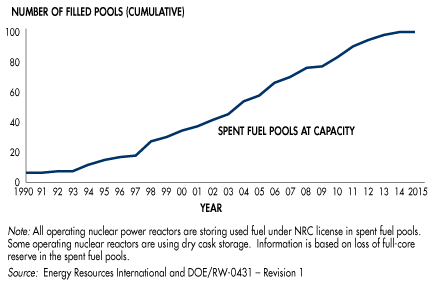
Estimated "wet storage" capacity at reactors, per the NRC. 
Indeed, spent fuel storage at reactors is a growing problem, made worse by the stalemate over Yucca Mountain. Coloring much of the report are concerns over the events at Fukushima, most especially in terms of managing spent fuel pools which are quickly reaching capacity.

Thus, concerns over waste management have begun to intersect with safety concerns, leading to an increase push for "dry storage" of older fuel. The safety concern is somewhat ill-placed, given that only older fuel (generally on the order of 5-10 years following final discharge) can be safely placed in dry storage (as the decay heat of such fuel is low enough to allow for air cooling). The fuel bundles which can be thus moved out of "wet storage" are thus not those at risk of damage in the event of a loss of coolant in the spent fuel pool; rather, any move to remove these bundles has more to do with lowering the total amount of radioactivity in the pool (as well as increasing safety margins in the pool) as well as making room for newer fuel being ejected from the core.

Yet dry storage is neither a substitute for wet storage ("younger", hotter fuel can't go into dry storage) nor a substitute for permanent disposal (dry storage casks, while being suitable for storage on the order of decades or more, is not designed to permanently isolate spent fuel from the environment and is subject to environmental attack).

However, all of this assumes no change from the once-through cycle, where only a fraction of the usable uranium is fissioned and the entire fuel assembly is thrown away with no further recovery of usable materials.

"Buying time" with interim storage

This is perhaps the most glaring flaw in the Commission's report; despite soliciting the testimony of numerous fuel cycle experts (and even in some cases, nuclear energy opponents), the capstone of their recommendations - centralized interim storage - amounts to a rather sophisticated way of simply buying time. In evaluating each of the technical solutions to nuclear waste management, the Commission declined to endorse any, concluding that interim storage leading to some form of geologic disposal is ultimately necessary:
We concluded that while new reactor and fuel cycle technologies may hold promise for achieving substantial benefits in terms of broadly held safety, economic, environmental, and energy security goals and therefore merit continued public and private R&D investment, no currently available or reasonably foreseeable reactor and fuel cycle technology developments—including advances in reprocess and recycle technologies—have the potential to fundamentally alter the waste management challenge this nation confronts over at least the next several decades, if not longer. Put another way, we do not believe that today’s recycle technologies or new technology developments in the next three to four decades will change the underlying need for an integrated strategy that combines safe, interim storage of SNF with expeditious progress toward siting and licensing a permanent disposal facility or facilities. This is particularly true of defense HLW and some forms of government-owned spent fuel that can and should be prioritized for direct disposal at an appropriate repository.
(Emphasis added).

A resonant theme throughout the report is the idea of "keeping one's options open" - in other words, avoiding any irreversible commitment to one technological choice, be it direct disposal or reprocessing. Hence one finds the conclusion for interim storage - a solution which is by its nature temporary. A key problem here however is that temporary solutions, while affording flexibility down the line, are also solutions which leave the issue still unresolved - the very problem which forced this crisis to begin with.

In fairness, the Commission found numerous technical and economic advantages to centralized interim storage, including reducing overall costs for security (especially compared to spent fuel stored at reactors which have been shutdown); the savings in comparison to on-site storage each reactor would make such a site largely self-financing, particularly given the cost of "orphaned" fuel at shutdown reactors. Additionally, centralized storage may afford certain new technical capacities such as mixing spent fuel assemblies in disposal packages in order to "even out" thermal loading in the repository. Finally, an interim storage site could easily be used as a staging area for both reprocessing or as a location to coordinate  final geologic disposal of assemblies.

So where exactly is the problem? The problem is in that this is it. Outside of recommendations for the process of repository siting, this is where the endorsements of technical solutions for nuclear waste management by the Commission end. Hence, the problem. One wonders why it took an entire commission of experts over a year to come to a set of solutions that, while helpful, have been already proposed by nuclear experts (including myself) for any number of years now.


To their credit, the Commission at least acknowledges the connection between interim storage and a credible process for establishing a repository, noting that the two activities cannot simply be carried out in isolation (particularly lest the centralized interim storage site be seen as a de facto permanent site).
Not that Deus Ex...


Yet much of their conclusion, and in particular their reluctance to endorse any of the suite of technological solutions for waste, implies waiting for some form of transformational technology whose technical and economic benefits solve their problem for them. Unfortunately, this is what folks in literature like to refer to as a "Deus Ex Machina" - in other words, a contrivance in which a divine entity swoops in and saves the hero from an otherwise insolvable crisis.

Overlooking incentives

One rather glaring omission in the Commisssion's report is an evaluation of the economic incentives "baked in" to current nuclear waste management policy. As of now, nuclear operators pay a $0.001/kWh fee to the federal government for each unit of electricity produced. While fine in theory (a "polluter pays" arrangement is certainly a forward-thinking way of handling such issues), this overlooks several perverse incentives such a policy produces by using a flat fee arrangement.

First is the linkage between the spent fuel and repository capacity. The overall capacity of a geologic repository is controlled chiefly by temperature - in other words, by the heat being produced by spent fuel rods. This in turn is linked to content of the rods - over the short term (i.e., the first 100 years following emplacement), the primary heat generators are radioactive cesium and strontium, each with half-lives of about thirty years. Thus, after about 100 years, the inventory of these isotopes (and subsequent heat) has decayed to roughly one-tenth of the original content. Over the extreme long-term (i.e., thousands of years), the heat capacity of the repository is controlled by long-lived actinides, specifically plutonium and americium. 

Were these species removed, technical studies have shown that the capacity of the repository could be increased ten to a hundred-fold in the same physical footprint, thereby eliminating the need for additional repositories. Thus, reprocessing spent fuel plays a critical role in such a planning process.

Yet the current fee structure does not charge based on the relative heat content of fuel (or, similarly, volume and total activity). There is thus no built-in incentive for operators to thus seek out ways to minimize these quantities - either through extended on-site storage (i.e., allowing time to do some of the work for them before shipping off waste for disposal) or reprocessing.

Additionally, because the fees are paid as power is generated, rather than when waste is disposed, the cost of disposal has already been "paid for" - and very few utilities (private or public) are so public-spirited as to pay twice for the privilege of waste management (such as paying for the cost of reprocessing fuel).

While uranium and plutonium can be recovered for re-use in spent fuel, reprocessing is expensive compared to mining and enriching new uranium from the ground; estimates show that the cost of raw uranium ore would have to rise appreciably - as much as ten times the current price - to make reprocessing competitive with mining an enriching new uranium. This of course frequently used as an argument by the opponents of reprocessing, but what this fails to account for is the cost of disposal; in particular, it is assumed the cost of disposing of waste is fixed. Yet this assumes after one repository fills, the next will be equally as inexpensive to locate and construct - a rather tenuous assumption. (Additionally, this line of argument neglects the consideration that fuel composes a tiny 10% of electricity costs for nuclear; thus, additional cost premiums for reprocessing are in essence a drop in the bucket.)

An alternative would be a pricing strategy which takes scarcity into account, which charges on the basis of total heat content (and potentially volume and activity) rather than in terms of electricity produced alone. Likewise, charging said fee at the time of disposal rather than immediately would encourage alternative solutions, from reprocessing to interim storage. (The issue of "stranded costs" could easily be handled as reactor decommissioning costs are now, where utilities are required to set aside funds during the operating life of the reactor to pay for its decommissioning and final disposal).

Missing the connection: nonproliferation

An additional point of emphasis in the BRC report is in the connection between the fuel cycle (specifically, waste management) and nonproliferation concerns. Nonproliferation has been (rightly or wrongly) at the fore of nuclear waste management decisions, from President Ford's temporary moratorium on domestic reprocessing, followed by President Carter's permanent shutdown, premised explicitly on nonproliferation concerns.

The BRC report correctly recognizes the linkage between waste management and nonproliferation, in particular the need for multilateral fuel cycle strategies that obviate the need for the spread of sensitive fuel cycle facilities (such as those for enrichment and reprocessing). While the topic of nonproliferation and the fuel cycle easily warrants its own post, in general a U.S. policy of fuel "leasing" (where fuel is enriched and manufactured here, leased to foreign reactors, and returned to the United States for final disposition) can be a vital tool in promoting a more proliferation-resistent fuel cycle cycle.

This argument is explicitly explored in the report; however, what is neglected is that absent a credible, permanent solution for waste, such a "fuel leasing" policy is politically dead in the water. Further, even assuming the development of a permanent repository, it is difficult to conceive of widespread public support for such a policy, given the limited availability of repository capacity.

This would be where the disconnect emerges; in order to credibly advance a fuel leasing strategy (thereby advancing nonproliferation goals), it is highly likely that some form of waste reduction would be required in order to minimize demands upon any given repository. In other words, half-measures such as interim storage are simply insufficient.

Conclusion

The BRC was obviously handed a rather trying and delicate task - trying to untangle three decades of U.S. nuclear waste management policy which had largely found its way into a dead-end. And while many of its instincts are admirable - such as advocating a strategy which is flexible and avoids technological lock-in, this philosophy is taken to an extreme, leading to paralysis in advocating a path forward. Instead, most of what the commission has produced is a call for additional breathing room - itself not bad, but a far cry from the long-term solutions required for spent fuel management.

While a rethought process for siting a geologic repository may fill some of this role, the Commission's reluctance to endorse any technological solutions to waste management (or a clear decision framework for adopting such a technology) is perhaps the report's most glaring shortfall.