Showing posts with label health physics. Show all posts

Saturday, January 28, 2012

Cultural bias and nuclear

I was recently perusing the comments on an NPR article on nuclear waste disposal, ("How to find a nuclear waste site? Woo a town."). In perfectly foolish measure, I perused the comments - a bad idea for anyone with an IQ north of room temperature and a level of patience south of Mahatma Gandhi. I found myself taken aback with, to put it bluntly, the level of gross ignorance of nuclear opponents. A couple of examples:

[...]The truth of the matter is that, to prevent dangerous overheating of nuclear waste, the rail cars used to ship the waste would allow air to move freely which also meant radiation could move freely. While it would just be small amounts of radiation, this could add up for families living next to railways and cause a multitude of health problems.[...]
So, we don't UNDERSTAND nuclear and our little waste problem. This condescending, ridiculous bantor from the industry nver ceases to amaze me. The industry's problem is that more people are beginning to understand the dangers of nuclear. The lifespan and inability to rid ourselves of it was reason enough to have never began this horrid mess. Indeed, I DO understand and, therefore,I want this needless perpetuation of nuclear to end! 
 My reaction to the first of the above was almost to say aloud in Morbo fashion (from Futurama, to the uninitiated), "Windmills do not work that way!" In other words, it conveys a serious lack of understanding about just how radiation works.

Image credit: NRC
To explain it briefly - ionizing radiation (i.e., the kind that can cause health problems) doesn't just blow around like dust in the wind - it comes from a source: like the atoms decaying inside nuclear fuel, or the sun for instance. (Yes, the sun - ever wonder why you get a sunburn from staying out in the sun too long? You just got a very mild radiation burn.) For gamma radiation, (i.e., energy emitted from nuclear transitions, ranging from ultraviolet rays to x-rays to gamma rays), this travels in a straight line, just like visible light - because it is light; it doesn't simply scatter to the wind. Further, it attenuates strongly as a function of both distance and shielding; fuel transport casks are designed such that a person standing directly next to the cask would have to stand there for any awfully long time to get anything approaching a dangerous level of radiation exposure, but further, gamma radiation attenuates as the square of the distance. In other words, for every factor of 10 one moves away from a radiation source, the exposure drops by a factor of 100.

A standard rail shipping cask (courtesy Wikipedia)
But getting back to the issue at hand - yes, casks are air-cooled, but so what? For radiation to "move freely" as the commenter describes, this would require radioactive material to move freely. Yet the transportation casks are clearly designed such that heat from the fuel is conducted to the outside of the cask, where it is carried away by convection. In no way does the fuel get exposed to air, the only plausible way in which this event could happen (i.e., particles of the fuel itself allowed to be picked up into the air and carried away). To further put this myth to rest, these same casks have to be tested against all kinds of conceivable accident scenarios - drops, fires, punctures, crushes - anything that the fuel container could possibly experience in an accident condition.

Below is a video released by Sandia National Laboratories demonstrating the types of tests performed on an older design of the transportation casks:


Basically, any cask which is certified to transport used nuclear fuel must go through a battery of punishing tests before it is ever licensed to transport fuel.

Getting back to the main point here - namely, that the information on safety is out there and widely available, how is it that such gross misinformation still manages to persist? The second comment seems to point to a a particular phenomenon - cultural bias which ultimately leads to mistrust of the (accurate) information being given by experts. If you will forgive the (slight) hyperbole:
  1. Nuclear energy is an industry run by giant, evil corporations with no regard for human life
  2. Information conveyed by nuclear experts and supporters is chiefly in service to the above
  3. Therefore, technical experts in nuclear are untrustworthy.
Hence we get have people resorting to "folk science" (in other words, lies) peddled by hucksters with their own agendas - be they political or economic in nature. (One can already begin to see the irony forming here.) Or you get the "proud ignorance" - "I don't need to know anything to know this is dangerous and you're lying to me!"

How do we get around this? I confess that I'm not an expert in this realm (I mean, after all, my first thought reading the above comments was to simply apply palm to face and mutter, "Windmills do not work that way!") But it does seem like there is a strong need to present a human element to this, conveying above all else that we, too share their (valid) concerns over the health and safety of our respective loved ones, and as such we have the utmost interest in obtaining and conveying accurate information.

Of course, a lot of us do this already - sometimes on a daily basis. A large part of the problem seems like an inability to penetrate "hardened" ideological structures where such ideas are formed and reinforced. And certainly, this applies far more broadly than just nuclear technology - think global warming, for example - a near-mirror image of this same phenomenon can be observed (accusations of science being manipulated for economic and political interests, etc.) If anything then, this seems to speak of a larger societal problem in conveying scientific and technical information about risk to the public.

Monday, January 16, 2012

When the cure proves more harmful than the disease

Recently, the Boston Globe published a series of haunting images taken from the evacuation zone surrounding the stricken Fukushima plants. Perhaps what is most striking is the unearthly nature of the abandoned towns, now turned feral, their only inhabitants being abandoned pets and livestock. These are more snapshots from a post-apocalyptic wasteland; it is difficult to imagine these as bustling, populated places less than a year ago.

Several news agencies have taken up the issue of the evacuation zone, referring to it as "poisoned" and "uninhabitable for decades to come." And of course, taking a look at maps such as that put out by the Washington Post, indeed the situation does look quite grim. (For an excellent, authoritative view of the data, the NNSA has continued to publish updated radiation measurements).

The evacuation zone - and the surrounding dire rhetoric - is founded on the idea of maintain a "safe" level of annual radiation exposure, set as 20 milliSieverts (mSv) per year, or 2 rads/year. (Note that the NRC limits for the general public are 1 mSv/year for the general public, and 50 mSv/year for radiation workers). By contrast, an average member of the public would receive on average 4 mSv/year simply from natural and synthetic sources of radiation each year (including x-rays, CT scans, and the like).

Yet without getting into the issue of radiation hormesis (i.e., the theory that low doses of radiation may show an overall benefit), the epidemiological understanding of radiation risk from protracted exposures at levels under 50-100 mSv is extremely murky. (This is not to assert no long-term risk of excess cancers exists for this level, but simply that our currently understanding of this risk is extremely limited). Conversely, long-term doses above 100 mSv have been shown to contribute to an excess risk of cancers.

Two critical questions should arise at this point. First, what risk exactly is the 20 mSv/year limit based upon? For reference, estimates of radiation doses from smokers put their annual doses around 150 mSv/year (due to polonium-210 deposited into smokers' lungs). While clearly no one should endorse smoking as a healthy life choice, it is regardless a risk that individuals freely make each day at that we as a society (reluctantly) accept. In this sense then, why is the government of Japan making a choices of risk for thousands of displaced individuals at thresholds far lower than individuals themselves accept?

Taking the linear-no-threshold model (LNT) at its face, a common value for excess fatal cancers is assumed to be 0.005 fatal cancers / Sv (i.e., 0.00005 fatal cancers / mSv; the value established by NCRP 115). Assuming a dose of 20 mSv/year, this leads to an overall increase in risk of fatal cancer of 0.03 over 30 years - in other words, 1 in 33 individuals can be expected to develop an excess fatal cancer over a period of 30 years. That comes down to 1 fatal cancer per year per 1,000 individuals exposed - a rate approaching statistical noise.

Still sound scary? Let's put this into the context of other common everyday risks:


RiskOrder (death/year)
Meteorite impacts~0.000000001
Radiation risk to U.S. population from nuclear power plant~0.00000001
Radiation from high-altitude flight~0.0000001
Lightning~0.0000001
Radiation death from consumer products~0.0000001
Flood, tornadoes, or earthquakes~0.000001
Death from cholera or whooping cough~0.000001
Train passenger death~0.000001
Natural background radiation~0.00001
Passenger deaths in aircraft accidents~0.00001
Death from leukemia or tuberculosis~0.00001
Brain damage from whooping cough vaccination~0.0001
Overall road accident deaths~0.0001
Death from bronchitis or influenza~0.0001
Death from childbirth0.00024
Lung cancer risk from smoking (20 cigarettes/day)~0.001
Death from all causes at age 55~0.001
Death from cancer, stroke, or heath disease~0.001
Deaths from 20 mSv exposure (Fukushima exposure limit)~0.001

In other words, the absolute limit on exposure established by the Japanese government corresponds to roughly equal that of the mortality risk of an average smoker (assuming conservative projections of low-dose risk). Beyond this, residents are to be permanently exiled from their homes.

Now conceive of a relatively conservative limit of even 50 mSv/year - a little over double the current exposure limit. From the above exposure maps, this would roughly halve the area requiring permanent evacuation ("permanent" in the sense of on the order of 30 years given the half-life of Cs-137, assuming no further decontamination). This would lead to a risk of about 0.0025 cancer deaths per year - 1 in 400. 

While such a certainly not trivial (although based in conservative projections), the question which should be asked is, "Compared to what?" Those evacuated have been deprived entirely of their livehoods - homes, farms, businesses, and ancestral lands. Clearly, they should be made whole by TEPCO, and failing this, the Japanese government. Yet the additional risk of death from cancer should be balanced against the very real physical and emotional costs of a mass involuntary exodus (not even taking into account the economic consequences for both those impacted and the country as a whole). What is the toll in terms of premature death from stress and associated mental health disorders (including alcoholism, depression, etc.) In essence, what is the cost in terms of human life from a forced exile? 

Nor are forced evacuations without cost - recently, Japan's blanket 20 km evacuation order recently came under fire due to its generic nature (ignoring real-time radiation exposure data, showing that contamination was spreading in a northwestern direction due to seasonal winds). As a result, many individuals received a higher dose than that if they'd simply stayed in place (due to evacuating to the northwest). Likewise, these evacuations themselves necessitated leaving homes (areas where radiation exposure is lower) and taking up residence in less sanitary conditions with greater exposure to the outdoors (increasing overall exposure). Thus, evacuation itself is not without risk. Each alternative must be evaluated for its own inherent risks - there is no free lunch.

I am not about to assert that there is zero risk from allowing residents to return - namely because the data regarding prolonged low-dose exposures is too poor to make a definitive assessment of risk. However, what should happen is that residents themselves should be allowed to make this choice from themselves - rather than the government. Perhaps one of the most disturbing images of the Fukushima evacuation zone is the constant vigil of police forces enforcing the no-entry zone; an act done ostensibly for residents' "own good," despite the legions of family pets and livestock abandoned to starvation or a return to ferity.

Within reason, these are risks residents should be allowed to evaluate on their own in an informed manner, rather than having them imposed upon them.

Monday, March 14, 2011

Radiation: A brief primer

Cyrus' prior post on radiation counts gives a good opportunity to segue into a brief lesson into different radiation types and their relative health impacts.

First, it is useful to sort out radiation into two categories - non-ionizing and ionizing radiation. Only the latter is of serious concern to long-term health effects. Electromagnetic radiation at visible energies and below generally lacks sufficient energy to cause disruptions to cells or DNA. At ultraviolet energies and above, radiation can cause cellular damage (as Cyrus pointed out, this is exactly what is happening when you get a sunburn...)

But even this picture isn't quite complete; namely, because not all radiation is created equal. While most of what we consider "radiation" (particularly, ionizing radiation) falls into the categories of X-rays and gamma rays, there's more to it than this.

First, there are three different types of ionizing radiation, including ionizing radiation from photons, alpha radiation, and beta radiation. Each of these different types of radiation comes from a different source and can be stopped in different ways.


Electromagnetic radiation: photons


X-rays and gammas are photons like radio waves and visible light, only having shorter wavelengths and higher energies. X-rays are emitted when electrons change energy state in the atom, while gammas result from changes of state in the nucleus itself (including fissions). How deeply penetrating EM radiation is depends upon its energy; the more energetic the photon, the thicker the shielding required. Generally speaking, photons require the greatest amount of shielding, being "deep" penetrating radiation. This type of radiation is best stopped by materials with high atomic number, with dense materials such as lead.

Interestingly enough, the fact that photons pass through less dense materials (and are stopped/absorbed by denser materials) is how an X-ray scan works. Bone is much more dense than blood vessels or soft tissue - thus, X-rays pass through with much greater frequency than they do bone. By exposing a film behind the object, an X-ray is used to scan internal objects (like bones) by looking for the spots on the film where fewer X-rays arrive (i.e., they've been stopped by bone).

(Image source: Wikipedia)


"Alpha" radiation


"Alpha" particles are really just a fancy term for a helium nucleus with no electrons. Compared to other forms of radiation, it's big, heavy...  and slow. Alpha radiation is the least penetrating type of radiation, capable of being stopped by a thin piece of paper or the outermost layers of your skin. Alpha radiation is thus not generally dangerous unless ingested into the body, either by eating or breathing.

Alpha radiation tends to be special in that it is generally ejected from very heavy nuclei like uranium, thorium, and other very heavy elements, along with their decay products. For example, if you live in an area with a large amount of natural granite deposits, particularly if you have a basement, chances are good that you've had to have your basement tested for radon gas. Radon is a decay product of natural uranium in the ground (which is often found along granite deposits).
The uranium decay series (courtesy: Wikipedia)

While radon is a noble gas (and thus of little concern on its own), the health hazard comes from ingesting radon into the lungs, where it decays into polonium (which sticks inside the lungs, producing several "daughter" alpha decays).

Likewise, if you smoke, chances are you're getting a heavy dose of radium directly to your lungs, as radium tends to "stick" to tobacco leaves, where it is ingested when the tobacco is burned and inhaled; this radium decays via series of rapidly decays to Polonium-224 - the same thing used to poison former KGB agent Alexander Litvinenko a few years back. (Another very good reason not to smoke!)


"Beta" radiation


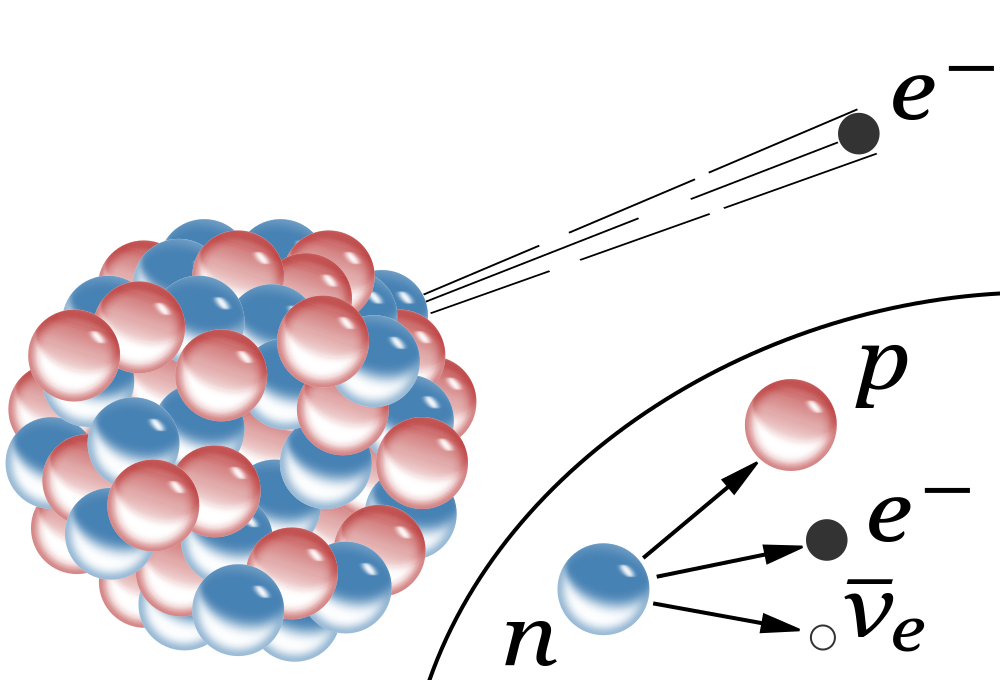
So-called "beta" radiation consists of electrons and their anti-particle, "positrons." Beta radiation is produced when a nucleus decides to "change" its configuration. Nuclei tend to prefer a certain ratio of protons to neutrons - too many protons, and the nucleus will try and "push" itself apart from the repulsion generated by like charges. Neutrons tend to act as a "buffer" in the nucleus, along with the strong force which binds the nucleus together.

However, despite being electrically neutral, nuclei tend to prefer not having "too many" neutrons either. When the number of protons or neutrons is "out of balance," nature will often employ the weak force to change the "flavor" of a proton (or neutron) to a neutron (or proton). In this process, electrical charge is conserved - a (negatively charged) electron or a (positively charged) positron are emitted. Likewise, a "ghost" particle known as a neutrino is also emitted - "ghostly" in that they have very small (almost non-existent) mass and no charge (and thus they barely interact with matter).

Beta radiation from a nucleus and  free neutron, respectively. (Courtesy: Wikipedia)

Beta radiation can generally be stopped by a thin piece of metal. While it is more penetrating that alpha radiation (beta is considered "shallow" penetrating radiation), for an external exposure it is generally a minor concern except for sensitive areas such as the lens of the eye; the chief concern for beta radiation again lies with ingestion.

Radioisotopes such as iodine and cesium fall into the category of beta emitters.


The dose makes the poison


When Cyrus mentioned the issue of radiation being (mis)-characterized in terms of its raw activity (i.e., the counts per minute), measurements of counts per second tell us nothing about the type or energy of that radiation. A raw count of radiation doesn't tell us what type of radiation being received (gammas, betas, or alphas), or what energy this is at. The difference is quite extreme - while no one would want to be contaminated with an alpha source, the solution would be quite simple - a change of clothing and vigorous scrubbing.

Second, doses are typically measured not by radiation counts alone, but by folding together both the count of particles (by type) with their energy. Radiation workers tend to be carefully tracked for their exposure to radiation through use of "TLD badges" (which stands for thermoluminescent dosimeter). This is where units such as rem and Sieverts tend to come into play - these units measure both the energy absorbed by the body as well as making a relative adjustment for the radiation type (called a "quality factor," which accounts for the fact that different types of radiation have different impacts). Thus, any relevant dose numbers tend to be reported in these units, rather than raw counts alone.

If you've ever been to a facility which makes regular use of radiation (such as a hospital or even possibly your dentist), you may have seen a badge looking like this:

A TLD ring and badge (Image courtesy of Princeton University)
These badges are worn on a person to measure their exposure to ionizing radiation, and thus provide a regular estimate of the dose this person is receiving.

Radiation effects are generally broken down into two types of categories: acute and stochastic (i.e., "random"). Acute effects generally only occur at very high exposures - these symptoms are caused when there is significant amount of damage to internal cells in the body (such as gastrointestinal cells and the nervous system). Symptoms of acute radiation exposure tend to include skin redness and irritation (erythema), nausea and vomiting.

Stochastic effects are produced from long-term exposure to lower levels of radiation, taking years or even decades to produce effects. Typically, this is what is thought of when people think of radiation's carcinogenic (cancer-causing) effects. Our estimates of stochastic radiation effects tend to be extremely limited, largely based upon studies of atomic bomb survivors in Japan. Generally speaking, the current assumption tends to extrapolate from known radiological exposures of atomic bomb survivors, who received relatively high doses, drawing a straight line backwards to zero dose. This is called the "linear no-threshold" (LNT) model of radiation, which assumes all radiation dose has some intrinsic probability of causing a cancer.

Experts disagree about the applicability of LNT model, due to the extremely limited data for lower radiological exposures - particularly given the fact that humans are regularly exposed to ionizing radiation from natural, background sources as well (such as from natural radiation sources in the ground, as well as others such as in potassium-40, found in bananas and other foods such as Brazil nuts). However, models such as the LNT model tend to form the basis of current exposure guidelines, such as what a normal acceptable dose for members of the public and for trained radiological workers can be, based on these assumptions of cancer risk per unit dose.


Further reading


NEI: Radiation in perspective

This guide (PDF) from the CDC gives a basic overview of units of measure of radiation, including commonly used prefixes (such as pico, micro, milli, etc.)

CDC: Radiation emergencies FAQ including a brief explanation of radiation health effects and how exposure can occur.